
2022 was one of the worst years on record for investment performance, with significant drawdowns for both equity and fixed income investors. The combined impacts of the Russia/Ukraine military conflict in Europe; continuation of Covid lock-down restrictions in China, the 2nd largest economy in the world; and to top it off, high inflation due to supply chain disruptions and the aggressive response from central banks, all set the stage for negative performance in 2022.
As discussed in the recent Brompton 2023 Market Outlook, our portfolio management team believes 2023 may be another challenging year, especially in the first half as the market continues to price in recession scenarios. While inflation has begun to decelerate, it remains elevated and there is still some uncertainty on the deceleration path. Central banks in both Canada and U.S. may continue their restrictive monetary policy with further interest rate hikes. The speed at which Central Banks have increased interest rates has caused some concern that tightening has gone too far, potentially pushing the economy into a recession.
In this article, we discuss several strategies that may help investors navigate today’s market uncertainties.
Stay Invested
Whether or not global economies enter a recession in 2023, in our view, now is not the time to sell investments. When a recession begins, it’s usually too late to benefit by selling stocks and bonds – the drawdown in equity or fixed income prices have typically already happened by the time investors read about it in the newspaper.
Recessions in the past have always been temporary, and investment performance tends to be strong off recessionary lows. The average length of recessions in the U.S. since WWII has been around 11 months, and the 2008 Financial Recession was the longest, with a duration of 18 months.
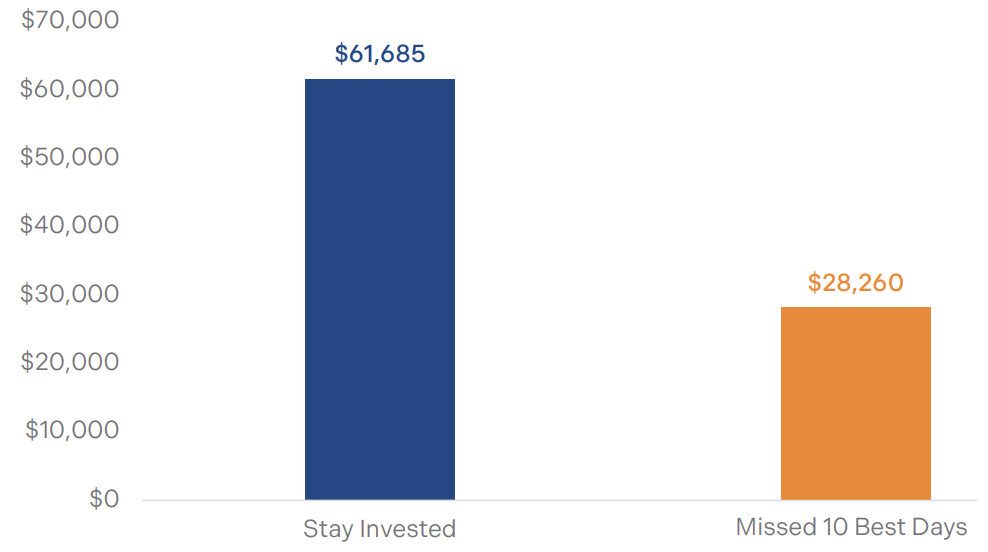
Investors should avoid panic selling and stay invested throughout the recession phase in order to benefit from market recovery opportunities. According to J.P. Morgan, the 10 best investment days over the 20 years ending in 2021 occurred after big declines of the 2008 financial crisis and the 2020 pullback during the onset of the Covid-19 pandemic. Attempting to time the equity market by selling can lead to investors missing out on meaningful positive investment performance.1
Growth of $10,000 from January 1, 2002 to December 31, 2021
Investment Strategies for Market Uncertainty
If you’ve made up your mind to stay invested, the next question is: what do I invest in? We have several suggestions for positioning your portfolio in a recessionary environment.
High Quality Dividend Growth Stocks
Dividend growth stocks tend to have competitive advantages and are leaders in their respective industry. The majority of dividend growth stocks have wide economic moats and healthy balance sheets; these companies can grow their profits during a strong economy while remaining resilient during recessions. The cash-rich nature of dividend growth stocks provide investors with strong downside protection during down markets and reliable dividend payments regardless of economic conditions.
Since 2000, dividend growers have consistently outperformed the broader market in down market years:

Healthcare Equities
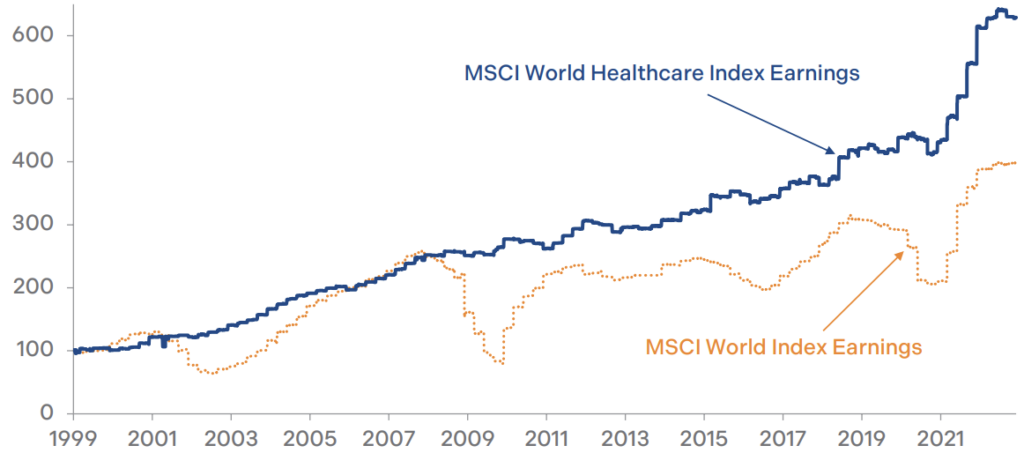
The healthcare sector provides both stable dividends and defensive characteristics. Demand for healthcare services will always occur and tends to increase as the population ages, and people are enjoying longer lifespans. Many large cap healthcare stocks can generate durable cash flows due to their diverse product offerings, and can be profitable even during recessionary periods. These are attractive defensive investment characteristics.
Healthcare Companies have delivered over 20+ years of steady earnings growth relative to broad markets.
Stable Earnings Growth Across Cycles
Diversified Portfolio
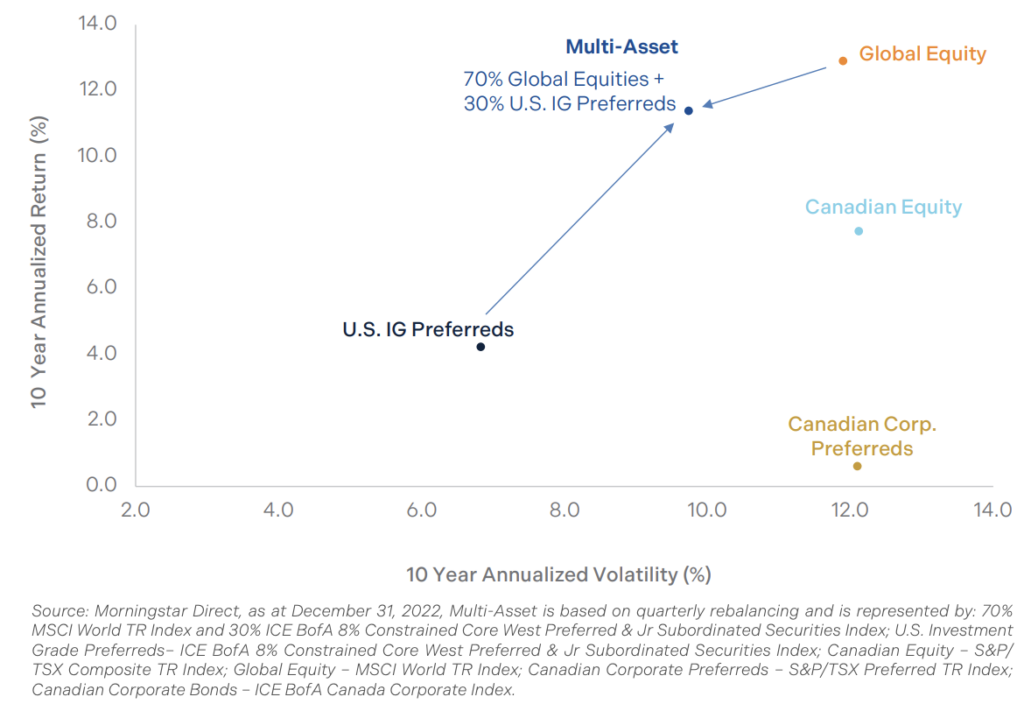
A well-diversified portfolio can help investors to weather through different market cycles. Depending on the investor’s risk tolerance level, a strategic asset allocation between asset classes, sectors, investment strategies and geographical regions should be able to reduce the overall portfolio volatility while providing investors with long term growth opportunities. The chart below demonstrates that combining global equities with U.S. investment grade preferred shares, as an example of a diversified multi-asset portfolio, generates a very attractive total return but also lowers the equity risk profile, as expressed through lower volatility.
Multi-Asset: Higher Risk-Adjusted Returns
Covered Call Strategies
By using a covered call strategy, portfolios can draw on three main sources of potential total return:
- Capital appreciation of the underlying equities in the portfolio
- Dividend income from the portfolio
- Premiums earned from writing call options
Market volatility can surge during recessionary periods, and this will result in an increase in option premiums. The increased premium collected through option writing should result in increased cash flows and provide additional downside protection for the client’s portfolio. Recessionary markets can be an ideal environment for covered call strategies.
Brompton’s Approach
Brompton offers a variety of Dividend Growth products including Brompton Global Dividend Growth ETF (BDIV), Brompton European Dividend Growth ETF (EDGF), Dividend Growth Split Corp. (DGS, DGS.PR.A), and Global Dividend Growth Split Corp. (GDV, GDV.PR.A), which are all designed to invest in well-diversified portfolios of high-quality, large capitalization dividend growth equities.
Brompton Global Healthcare Income & Growth ETF (HIG, HIG.U) provides diversified exposure to the global healthcare sector. In addition, we actively manage the healthcare weighting across our global dividend portfolios (BDIV, GDV, EDGF). We prefer to invest in healthcare companies that are market leaders with solid commercial product pipelines, versus early-stage healthcare companies. We believe this strategy provides better risk-adjusted returns, particularly in an inflationary environment. In addition, a diversified product pipeline mitigates risks associated with patent cliffs. We actively manage the sub-sector weightings within healthcare which is tilted towards companies with long/durable product cycles and lower research and development intensity.
Brompton Enhanced Multi-Asset Income ETF (BMAX) offers a unique, diversified multi-asset investment by combining covered call equity ETFs, U.S. Investment Grade Preferred Shares and Brompton Split Corp. Preferred Shares. The equity ETFs included in the BMAX portfolio are globally diversified across major developed markets. Investors may benefit from the long-term growth potential of high-quality companies and reduce the concentration risk of investing in one single region. Brompton’s equity ETFs also utilize covered call writing strategies which can further reduce overall portfolio volatility and provide enhanced income for investors. This unique approach to a multi-asset solution provides investors with attractive income as well as asset class and geographic diversification. BMAX provides investors with an efficient way to access a portfolio designed for various market conditions.
We also use an actively managed call writing overlay to harvest volatility risk premium which enhances riskadjusted returns for all of our equity ETFs.
(1) Returns are based on the S&P 500 Total Return, best days are those with the highest daily returns between Jan 1, 2002 and Dec 31, 2021. https://www. cnbc.com/2022/03/09/you-may-miss-the-markets-best-days-if-you-sell-amid-high-volatility.html.
This document is for information purposes only and does not constitute an offer to sell or a solicitation to buy the securities referred to herein. The opinions contained in this report are solely those of Brompton Funds Limited (“BFL”) and are subject to change without notice. BFL makes every effort to ensure that the information has been derived from sources believed to be reliable and accurate. However, BFL assumes no responsibility for any losses or damages, whether direct or indirect which arise from the use of this information. BFL is under no obligation to update the information contained herein. The information should not be regarded as a substitute for the exercise of your own judgment. Please read the relevant prospectus or annual information form before investing.
Commissions, trailing commissions, management fees and expenses all may be associated with exchange-traded fund investments. Please read the prospectus before investing. T Exchange-traded funds are not guaranteed, their values change frequently and past performance may not be repeated.
You will usually pay brokerage fees to your dealer if you purchase or sell shares or units of an investment fund on the Toronto Stock Exchange or other alternative Canadian trading system (an “exchange”). If the shares or units are purchased or sold on an exchange, investors may pay more than the current net asset value when buying shares or units of an investment fund and may receive less than the current net asset value when selling them. There are ongoing fees and expenses associated with owning shares or units of an investment fund. An investment fund must prepare disclosure documents that contain key information about the fund. You can find more detailed information about a fund in the public filings available at www.sedar. com. Investment funds are not guaranteed, their values change frequently and past performance may not be repeated.
Certain statements contained in this document constitute forward-looking information within the meaning of Canadian securities laws. In some cases, forward-looking information can be identified by terms such as “may”, “will”, “should”, “expect”, “plan”, “anticipate”, “believe”, “intend”, “estimate”, “predict”, “potential”, “continue” or other similar expressions concerning matters that are not historical facts. Actual results may vary from such forward-looking information. Investors should not place undue reliance on forward-looking statements. These forward-looking statements are made as of the date hereof and we assume no obligation to update or revise them to reflect new events or circumstances.