
Updated November 10, 2026: Originally published in July 2026, this article has been updated to reflect the latest available information. With inflation becoming an increasingly relevant consideration for investors, high free cash flow yield equities and their potential role as an inflation hedge remains highly relevant today.
Fund in focus: Brompton U.S. Cash Flow Kings ETF, Brompton Canadian Cash Flow Kings ETF, Brompton International Cash Flow Kings ETF, Brompton Global Cash Flow Kings ETF
The outlook for inflation remains uncertain given ongoing geopolitical risks related to the U.S.–Iran conflict and the potential for continued volatility in oil prices. Inflation may prove stickier than expected if energy prices remain elevated or if supply disruptions take longer to unwind. The global experience following the COVID-19 supply shock demonstrated that supply-side pressures can persist well beyond the initial disruption, delaying the return of inflation to target levels.
Take the U.S. as an example. CPI (inflation) rose 3.7% year-over-year in September 20261, continuing the trend above the Fed’s 2% target. Although mainly due to elevated energy prices, the Producer Price Index, which is often a leading indicator of the direction of future consumer inflation, advanced 6.3% y/y in September 2026, its highest increase since December 2022. This reflects the layering effect of tariffs, high energy prices due mainly to the ongoing war in Iran, and immigration-related supply constraints.2 Many of the same issues, with regional nuances, are driving inflation in the entire Developed world, such as high housing prices in Canada, the war in Ukraine and the delicate abatement of hostilities in the Middle East.
Free Cash Flow Yield (FCFY) outperforms when inflation rises
Companies with high FCFY, which is defined as high Free Cash Flow relative to its Enterprise Value (Market capitalization and debt), tend to outperform the broader equity market during times of growing inflation. Large and mid-cap companies are equally eligible for the index screen as FCFY ensures that each company in the respective universe generates high cash flow based on the relative size of its capital base. Below we compare the performance of the high-FCFY Cash Flow Kings index for equities in the US and Canada during three recent inflationary periods. In all periods, the Cash Flow Kings indices generated relative outperformance.
High FCFY Outperforms in Inflationary Periods
| Country | Avg. CPI Increase | Avg. PPI Increase | Average: KNGs Index Outperformance of Broad Index |
|---|---|---|---|
| Canada | 3.8% | 12.4% | 24.7% |
| United States | 4.5% | 6.7% | 23.7% |
Source: LSEG Workspace. CPI increase, PPI increase, Canada Cash Flow Kings Index outperformance of the S&P/TSX Composite Index, and U.S. Cash Flow Kings Index outperformance of the S&P 500 Composite Index, all averaged over the following rising inflation periods: April 2015 to July 2018; May 2020 to June 2022; Jan 2026 to Sept 2026.
Why Cash Flow Kings thrive during inflationary times
During inflationary times, future cash is expected to have lower purchasing power than cash today. Growth companies with expectations of cash flow far in the future tend to decline in value, while companies with current cash flows are more attractive.
Companies that demonstrate high FCFY generate more cash today than their peers, making their valuations far less sensitive to the rising interest rates and discount rates that accompany inflation. They tend to be mature firms with the pricing power to pass higher costs through, and because they largely fund themselves, they rely less on external financing as borrowing becomes more expensive.
Growth stocks, whose valuations rely more heavily on future cash flows, can experience significant multiple contraction during inflationary periods, but high FCFY equities act as a defensive buffer by providing immediate, tangible cash flow.
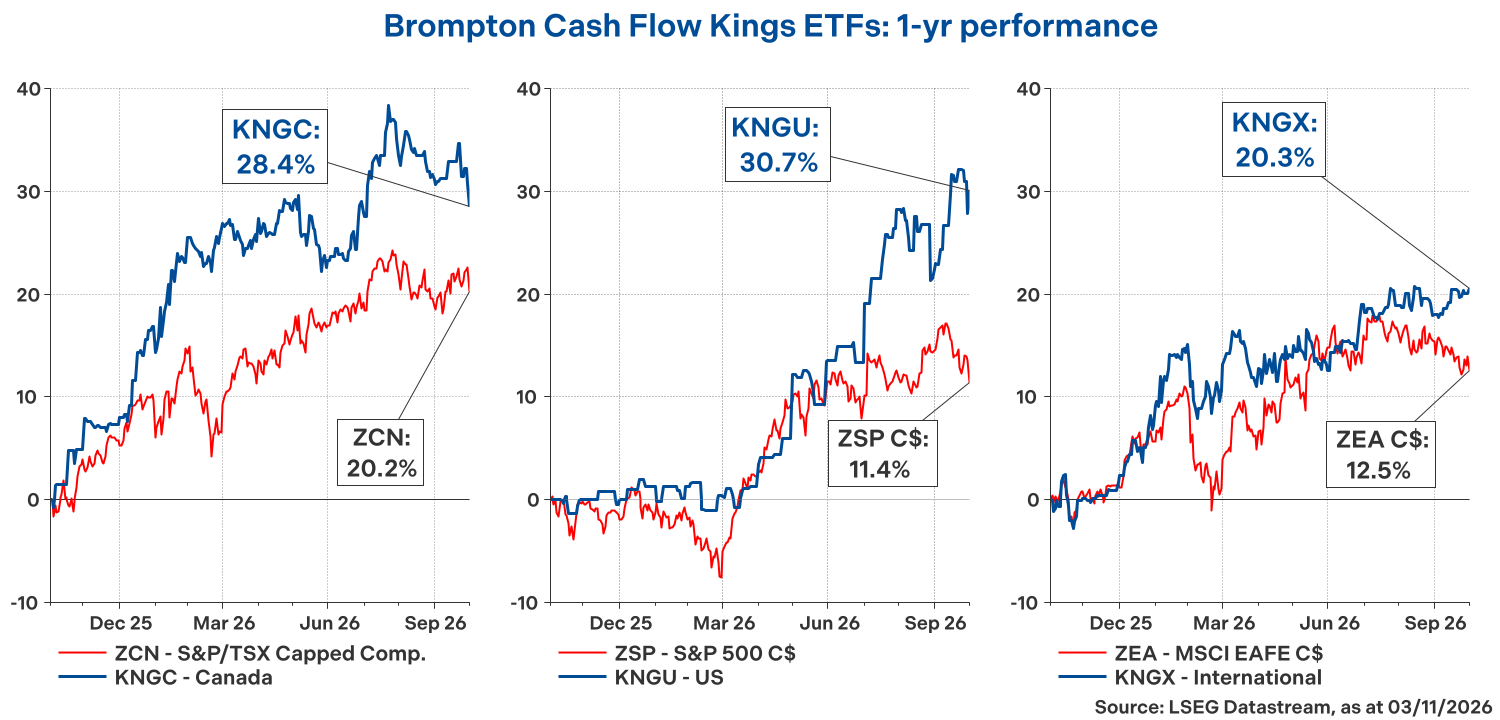
The Brompton Cash Flow Kings suite of ETFs have been performing very well in the current inflationary environment, as can be seen in the chart below, and we expect the FCFY factor to continue to contribute to the performance of these ETFs.
Four ways to access high FCFY
Investors can benefit by owning high FCFY equities during periods of growing inflation. Brompton offers four ETFs that give investors an easy, low-cost way to invest in high FCFY equities:
- KNGC – Brompton Canadian Cash Flow Kings ETF
- KNGU – Brompton U.S. Cash Flow Kings ETF
- KNGX – Brompton International Cash Flow Kings ETF
- KNGG – Brompton Global Cash Flow Kings ETF
Historical Performance³
| 1-Yr | 2-Yr | SI | Inception Date | |
|---|---|---|---|---|
| KNGC | 28.4% | 31.7% | 27.2% | May 30, 2024 |
| KNGU | 30.7% | 20.7% | 18.2% | May 30, 2024 |
| KNGX | 20.3% | 24.6% | 20.0% | July 16, 2024 |
¹ Source: LSEG Datastream, 27/10/2026. Cumulative total returns, C$. CPI figures in % year-over-year. Brompton Index One U.S. Cash Flow Kings Index tracks the performance of mid-to large-capitalization U.S. equities whose issuers exhibit high free cash flow relative to their enterprise value. The Index uses a rules-based methodology to gain exposure to shares of 50 U.S. publicly listed companies with the highest free cash flow yields. The S&P 500 Index covers large-cap U.S. equities and includes 500 leading companies, covering approximately 80% of available market capitalization. Brompton Index One Canadian Cash Flow Kings Index tracks the performance of mid-to large capitalization Canadian equities whose issuers exhibit high free cash flow relative to their enterprise value. The Index uses a rules-based methodology to gain exposure to shares of 35 TSX-listed companies with the highest free cash flow yields. S&P/TSX Composite Index tracks the performance, on a market-weight basis and a total return basis, of a broad index of large capitalization issuers listed on the TSX. The historical performance of the Brompton Index One Canadian Cash Flow Kings Index and Brompton Index One U.S. Cash Flow Kings Index (together the “Indices”) shown are hypothetical performance and should not be considered as a tradable portfolio and does not guarantee any future performance of the strategy. The Indices are not investment advice and should not be construed as investment advice. The Indices rely directly or indirectly on various sources of information to assess the criteria of issuers included in the Indices, including information that may be based on assumptions and estimates. Neither the ETFs, the index provider, or Brompton Funds Limited (“BFL”) can offer assurances that the Indices’ calculation methodology or sources of information will provide an accurate assessment of included issuers or a correct valuation of securities, nor can they guarantee the availability or timeliness of the production of the applicable index.
² Source: Economic Outlook U.S. Q3 2026: Resilient to Layered Supply Shocks, S&P Global Ratings, 2026.
³ Source: Returns are for the periods ended October 31, 2026 and are unaudited. Inception dates are noted in the table above. The table shows the ETFs’ compound returns for each period indicated. Past performance does not necessarily indicate how the ETFs will perform in the future. The information shown is based on net asset value per unit and assumes that cash distributions made by the ETFs during the periods shown were reinvested at net asset value per unit in additional units of the ETFs.
This report is for information purposes only and does not constitute an offer to sell or a solicitation to buy the securities referred to herein. The opinions contained in this report are solely those of BFL and are subject to change without notice. BFL makes every effort to ensure that the information has been derived from sources believed to be reliable and accurate. However, BFL assumes no responsibility for any losses or damages, whether direct or indirect which arise from the use of this information. BFL is under no obligation to update the information contained herein. The information should not be regarded as a substitute for the exercise of your own judgment. Please read the prospectus before investing.
Commissions, trailing commissions, management fees and expenses all may be associated with exchange-traded fund investments. The indicated rates of return are the historical annual compounded total returns including changes in unit value and reinvestment of all distributions and do not take into account sales, redemption, distribution or optional charges or income taxes payable by any securityholder that would have reduced returns. Please read the prospectus before investing. Exchange-traded funds are not guaranteed, their values change frequently and past performance may not be repeated.
Information contained in this document was published at a specific point in time. Upon publication, it is believed to be accurate and reliable, however, we cannot guarantee that it is complete or current at all times. Certain statements contained in this document constitute forward-looking information within the meaning of Canadian securities laws. Forward-looking information may relate to matters disclosed in this document and to other matters identified in public filings relating to the ETFs, to the future outlook of the ETFs and anticipated events or results and may include statements regarding the future financial performance of the ETFs. In some cases, forward-looking information can be identified by terms such as “may”, “will”, “should”, “expect”, “plan”, “anticipate”, “believe”, “intend”, “estimate”, “predict”, “potential”, “continue” or other similar expressions concerning matters that are not historical facts. Actual results may vary from such forward-looking information. Investors should not place undue reliance on forward-looking statements. These forward-looking statements are made as of the date hereof and we assume no obligation to update or revise them to reflect new events or circumstances.