
We expect 2023 will be another challenging year, especially in the first half as the market continues to price in recession scenarios. While inflation has begun to decelerate, it remains elevated and there is still some uncertainty in the deceleration path. The rapid pace of monetary policy tightening has been a headwind for risk assets but the expected moderation in rate hikes should become less of an overhang as the effects of recent policy decisions begin to reflect in the economic data. As the year unfolds, the market’s ability to price in a mix of growth, inflation, and recession risk should become more clear and provide support for risk assets. As a result, we believe investors should remain defensive in this volatile inflationary market regime.
Should investors stay invested? It is difficult to time the market. The best days in the market are coupled with the worst days since highly volatile markets have less liquidity and exhibit fatter tails in the distribution of returns. Rather than seek to time the market, we believe investors should embrace strategies that offer attractive risk-adjusted returns, such as dividend growth, low volatility, preferred shares, defensive sectors (staples, healthcare, real assets), and the ability to harvest volatility risk premia through covered call writing.
The Rear View
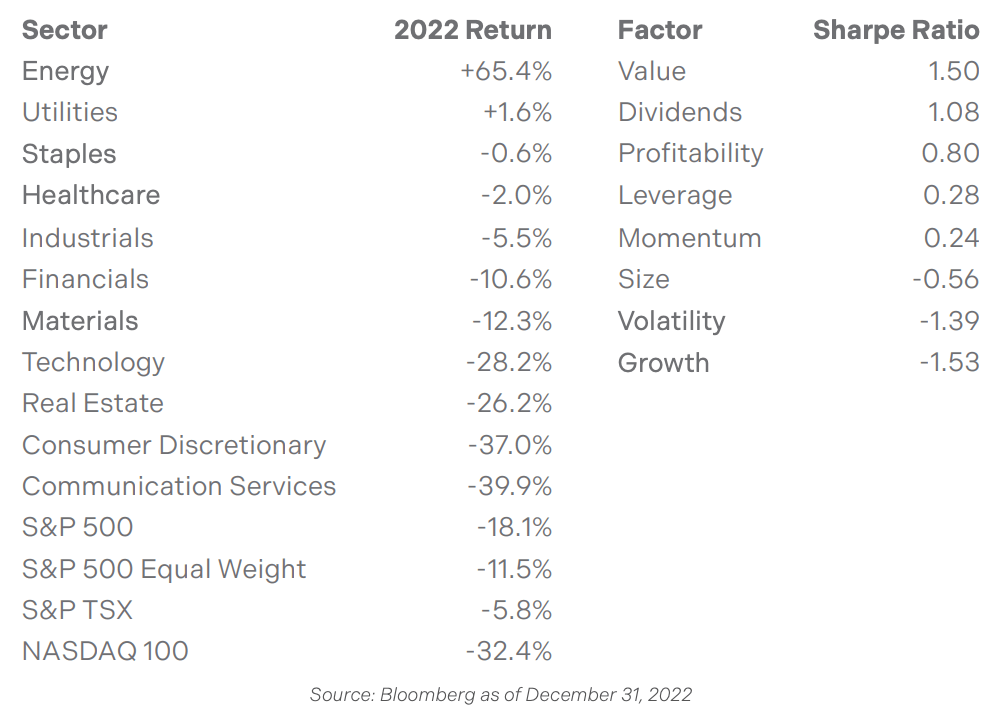
Investors can finally breathe a sigh of relief as 2022 is now in the past. While the S&P 500 and NASDAQ were down 18% and 32% respectively in 2022, performance was volatile with the indices enduring drawdowns of 25% and 35%, respectively. In contrast, the Canadian markets outperformed, with the TSX down 5.8% with a 17% drawdown. From an investment factor perspective (see table below), value generated the best riskadjusted returns, which came at the expense of growth. This resulted in energy significantly outperforming the market, while communications, discretionary, real estate and technology underperformed. We also saw rotation away from technology mega cap names given the headwind of interest rates, which resulted in the equal weight index outperforming the market cap-weighted benchmark by 660 bps.
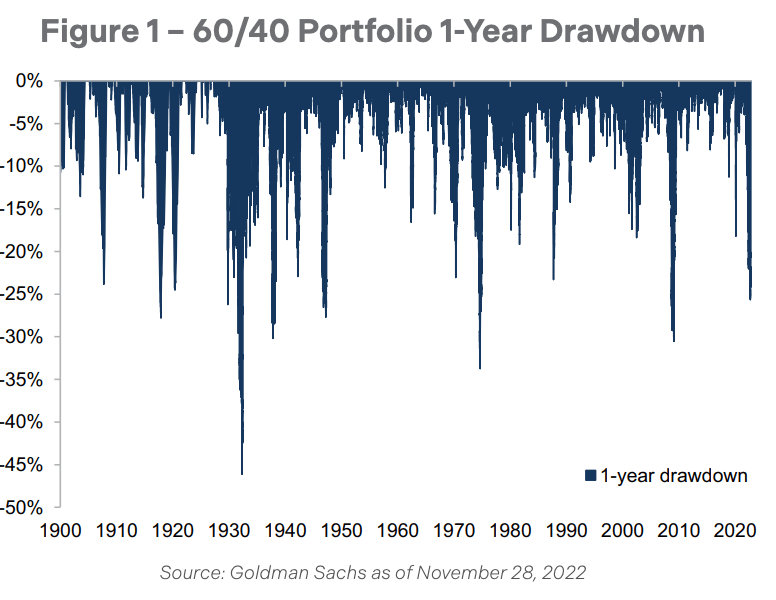
Heightened inflation, uncertainty surrounding the cadence of rising interest rates and geopolitical risk around the Russia-Ukraine situation were headwinds for risk assets in 2022. Additionally, lack of liquidity in equity and bond markets contributed to market volatility. In fact, realized volatility in 2022 was the sixth highest since the Great Depression and 2022 will likely go down in history for peculiar performance where both equities and treasuries suffered extreme drawdowns, with long duration treasuries even underperforming equities. As a result, the traditional 60/40 portfolio suffered a 25% drawdown, which is one of the largest since the Great Depression (see figure below).
While the 60/40 portfolio performance in 2022 was one of the worst, looking at the 10 worst periods in history, the 60/40 portfolio declined 16% at the median, and the following year the portfolio was up 17% on average, with exception of 1931 (Goldman Sachs December 9, 2022).
Pause Or Pivot
“I think we now understand better how little we understand about inflation” – Jerome Powell (June 29, 2022).
“We have got to get inflation behind us. I wish there was a painless way to do it. There isn’t.” – Jerome Powell (September 21, 2022).
Central banks continue to tighten monetary conditions at one of the quickest rates in history in order to tame inflation, which has risen at the fastest pace in over 40 years. While inflation appears to have decelerated during Q4 2022, it remains elevated and well above central bank targets. We believe it will take some time for inflation to cool as there is some stickiness to things like services inflation and lagging components like shelter. The pace of interest rate increases has begun to decelerate and rates is expected to be more modest in 2023. Having said that, we must acknowledge the path to inflation reduction is not a linear one as there are elements of structural inflation that will likely persist in the future. These include the reversal of many globalization trends, an under-investment in infrastructure and commodities, and the cost of implementing climate change and decarbonization policies.
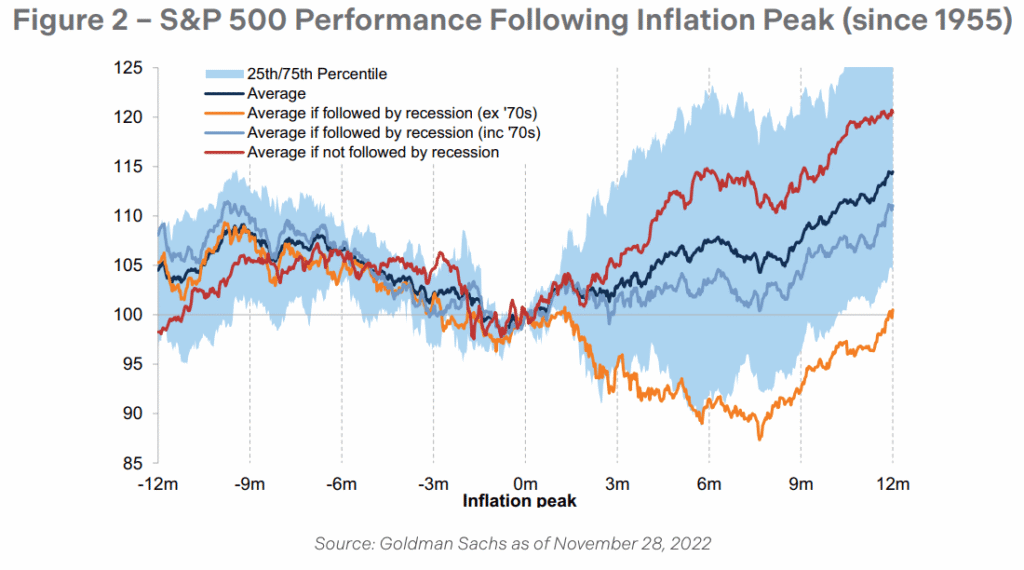
While inflation and monetary tightening were headwinds to risk assets in 2022, it is natural to assume that a potential equity recovery will depend on when inflation peaks. The answer is not so clear cut as there is a wide distribution of outcomes post peak inflation (see Figure 2 below). The performance of the S&P 500 post inflation peak depends on the risk of recession, the depth of a potential recession, and the central banks’ reaction function under a deep recession scenario or in response to exogenous shocks.
Recession Obsession
In 2023, we believe the market will begin to shift its focus towards recession risk rather than inflation, as the latter has begun to decelerate, but there exists uncertainty surrounding economic growth and the inflation mix. Sentiment has eroded recently given declining retail sales and manufacturing indices that are now in contraction territory. In particular, new orders, shipments, and employment components have all declined. We believe investors continue to be concerned about whether aggressive monetary tightening could lead to a recession. Looking at the last 12 recessions, including the 2020 downturn, the S&P 500 bottom often occurred within a few months of the ISM Manufacturing Index low according to Goldman Sachs.
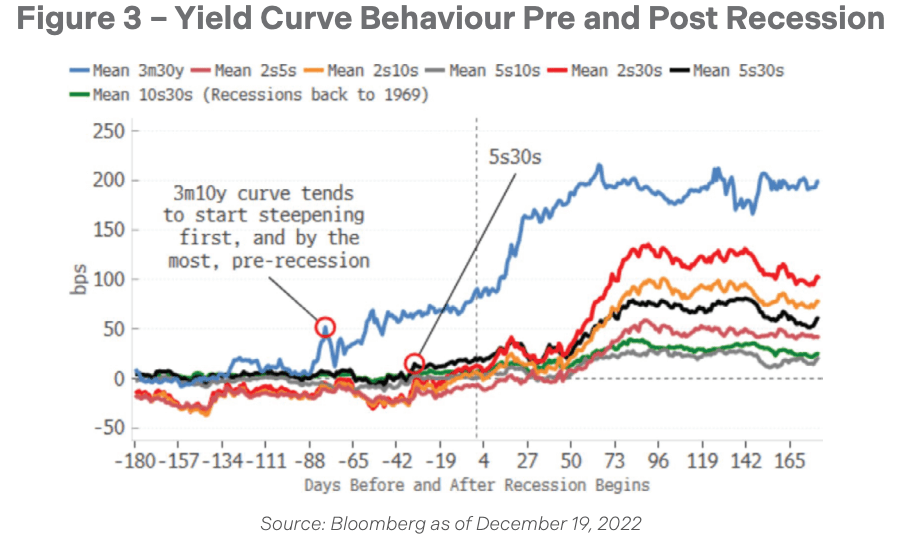
Investors are paying close attention to the behaviour of the yield curve as inversions typically precede recessions. Given the variability between when the yield curve inverts and when a recession hits, we believe there is not much utility in forecasting the timing of a recession based on the yield curve. If history is any guide, the steepening between the 3-month and 30-year yields has provided an indication of a recession within three months according to Bloomberg.
What To Expect In 2023
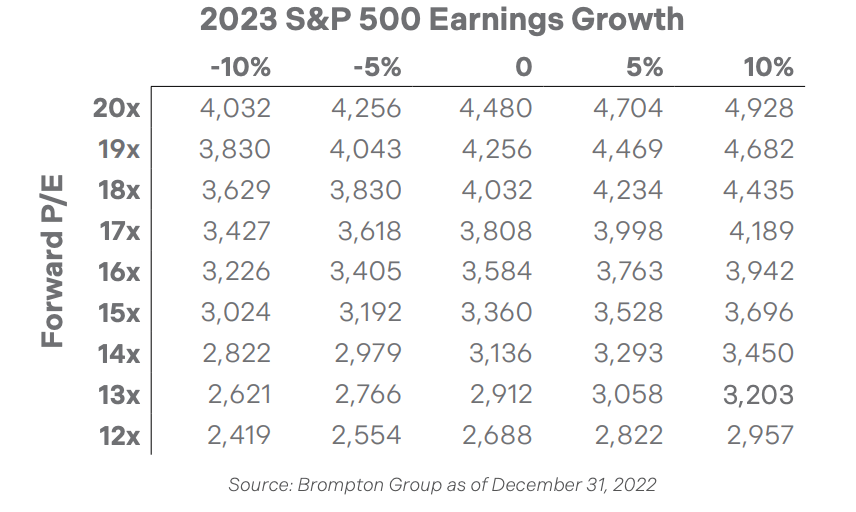
We are heading into 2023 with elevated bond market volatility. While the pace of monetary tightening will not likely exceed that of 2022, the uncertainty in the mix of growth, inflation, and recession risk will be an overhang to risk assets in the first half of 2023, in our view. We believe the market is slowly beginning to price in recession scenarios, as the S&P 500 is trading at 16.5x forward earnings compared to 19x in November 2022. While valuations have deflated and earnings have been revised downwards in 2022, consensus still implies 4% earnings growth for 2023. We believe when companies report Q4 2022 earnings in early 2023, estimates will likely be revised downwards early to reflect the underlying economic conditions, which have been weakening. In the table below we provide a sensitivity analysis of earnings growth versus valuations and implied levels of the S&P 500. In the back half of 2023 we believe that risk assets should get a bid as additional economic data emerges to provide more clarity to the uncertainty, and when forward valuations begin to reflect probabilities of a post-recession environment.
Brompton’s Approach
We believe investors should remain defensive in this inflationary and volatile market regime. In this environment, investments that generate inflation resistant cash flows and have a consistent track record of returning capital to shareholders in the form of dividends and buybacks are an attractive investment opportunity, in our view. In that regard, we believe real assets, staples and healthcare should perform well. In high volatility market regimes, strategies that lower portfolio correlations, such as investing in low volatility styles and preferred shares, should enhance risk-adjusted returns. Additionally, Brompton’s ability to lean on its covered call writing program to harvest volatility risk improves risk-adjusted returns by lowering portfolio volatility which aids in funding distributions.
This document is for information purposes only and does not constitute an offer to sell or a solicitation to buy the securities referred to herein. The opinions contained in this report are solely those of Brompton Funds Limited (“BFL”) and are subject to change without notice. BFL makes every effort to ensure that the information has been derived from sources believed to be reliable and accurate. However, BFL assumes no responsibility for any losses or damages, whether direct or indirect which arise from the use of this information. BFL is under no obligation to update the information contained herein. The information should not be regarded as a substitute for the exercise of your own judgment. Please read the annual information form or prospectus before investing.
Commissions, trailing commissions, management fees and expenses all may be associated with exchange-traded fund investments. Please read the prospectus before investing. Exchange-traded funds are not guaranteed, their values change frequently and past performance may not be repeated.
You will usually pay brokerage fees to your dealer if you purchase or sell shares of the investment funds on the Toronto Stock Exchange or other alternative Canadian trading system (an “exchange”). If the shares are purchased or sold on an exchange, investors may pay more than the current net asset value when buying shares of the investment funds and may receive less than the current net asset value when selling them.
There are ongoing fees and expenses with owning shares of an investment fund. An investment fund must prepare disclosure documents that contain key information about the fund. You can find more detailed information about the fund in the public filings available at www.sedar.com. Investment funds are not guaranteed, their values change frequently and past performance may not be repeated.
Certain statements contained in this document constitute forward-looking information within the meaning of Canadian securities laws. Forward-looking information may relate to matters disclosed in this document and to other matters identified in public filings relating to the Funds, to the future outlook of the Funds and anticipated events or results and may include statements regarding the future financial performance of the Funds. In some cases, forward-looking information can be identified by terms such as “may”, “will”, “should”, “expect”, “plan”, “anticipate”, “believe”, “intend”, “estimate”, “predict”, “potential”, “continue” or other similar expressions concerning matters that are not historical facts. Actual results may vary from such forward-looking information. Investors should not place undue reliance on forward-looking statements. These forward-looking statements are made as of the date hereof and we assume no obligation to update or revise them to reflect new events or circumstances.