
The global banking industry has once again been thrown into turmoil with the recent regional bank failures of Silicon Valley Bank, Silvergate Capital, and Signature Bank in the U.S., as well as the takeover of Credit Suisse by UBS Group at the behest of regulators in Switzerland. While there were specific issues impacting each of these entities, these recent failures have highlighted the risks associated with the rapid increase in overnight interest rates over the past year as central banks around the world have moved swiftly to tighten policy in response to high inflation. These risks include declining asset values (i.e. bond investments) as a result of higher rates across the yield curve, particularly for banks that run a duration mismatch on their balance sheets, as well as the potential for banks to quickly lose deposits as depositors search for higher yields in investment products and/or flee in the face of a real or perceived banking crisis.
While Canadian banks are not completely immune from these issues, we thought this was a good opportunity to remind investors of the strength of our banks and our banking system in Canada. There are several reasons why we think Canadian banks are well positioned to handle the uncertainty facing certain U.S. regional banks and European banks:
- Canada has an excellent track record when it comes to banking regulation, supervision and governance, and Brompton believes our banking system is among the most disciplined (ie. conservative) in the world. In fact, the Office of the Superintendent of Financial Insitutions proactively increased the required CET1 (Tier 1 capital) ratio by 0.5% in 2022.
- The Big 6 Canadian Banks are well capitalized with an average CET1 ratio of 13.7% as of the latest fiscal quarter (quarter ended January 31, 2023). This compares to 11.3% for the S&P 500 Diversified Banks and 9.5% for the S&P 500 Regional Banks (Source: Bloomberg).
- The Big 6 Canadian Banks run more diversified business models and have better deposit franchises than the U.S. Regional Banks. As such, they are better prepared to deal with challenges as they arise, and deposits tend to be stickier.
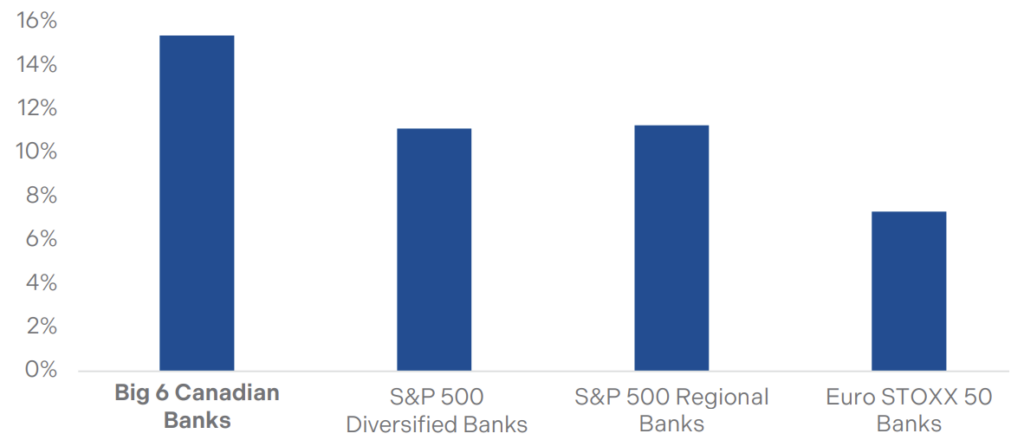
- Canadian Banks are more profitable than their U.S. and European peers (Figure 1). We believe that high profitability is the first line of defense in a crisis, as core profits can be used to absorb losses and/or rebuild capital in times of stress. In our view, this is the key differentiating factor for Canadian Banks and a key reason for why they have been able to weather past crises so well.
Figure 1: Bank Return on Equity (2018-2022 Average)
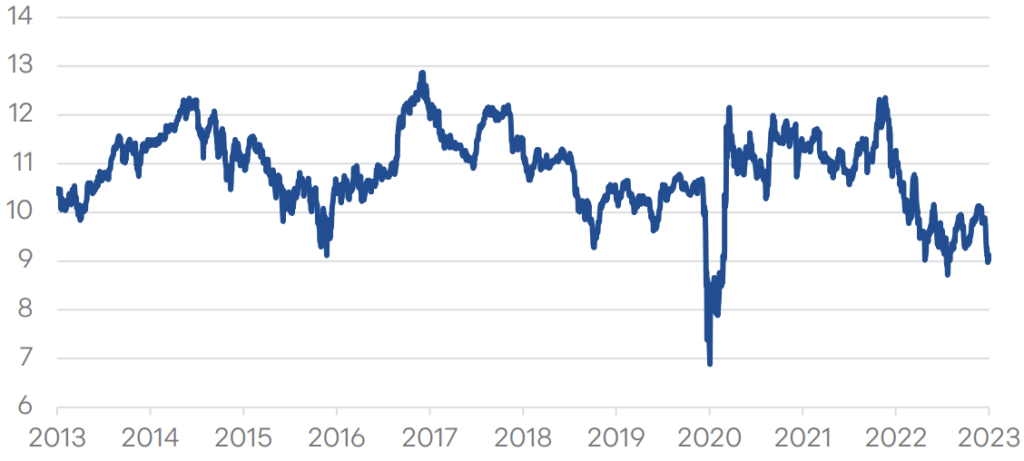
With the turmoil over the past few weeks, global bank stocks have sold off. This includes the Canadian Banks, despite being better positioned to handle the challenges facing the global banking industry. After this selloff, Canadian Banks now trade at 9.1x forward EPS (as of March 23, 2023), which is near the low end of the range experienced over the past decade excluding the early days of the COVID pandemic (Figure 2). As such, we believe Canadian Banks present an excellent buying opportunity for investors with a long-term view.
Figure 2: TSX Diversified Banks – Forward P/E Multiple
Brompton’s Approach
At Brompton, we have experience investing in Financials and have several products that investors can use to get exposure to banks, including in our split share funds and ETFs. The following Brompton funds all trade on the TSX and focus specifically on Financials:
| Fund Name | Preferred Share Ticker | Class A Ticker | ETF Ticker |
| Brompton Split Banc Corp. | SBC.PR.A | SBC | |
| Life & Banc Split Corp. | LBS.PR.A | LBS | |
| Brompton North American Financials Dividend ETF | BFIN |
This document is for information purposes only and does not constitute an offer to sell or a solicitation to buy the securities referred to herein. The opinions contained in this report are solely those of Brompton Funds Limited (“BFL”) and are subject to change without notice. BFL makes every effort to ensure that the information has been derived from sources believed to be reliable and accurate. However, BFL assumes no responsibility for any losses or damages, whether direct or indirect which arise from the use of this information. BFL is under no obligation to update the information contained herein. The information should not be regarded as a substitute for the exercise of your own judgment. Please read the relevant prospectus or annual information form before investing.
Commissions, trailing commissions, management fees and expenses all may be associated with exchange-traded fund investments. Please read the prospectus before investing. Exchange-traded funds are not guaranteed, their values change frequently and past performance may not be repeated.
You will usually pay brokerage fees to your dealer if you purchase or sell shares or units of an investment fund on the Toronto Stock Exchange or other alternative Canadian trading system (an “exchange”). If the shares or units are purchased or sold on an exchange, investors may pay more than the current net asset value when buying shares or units of an investment fund and may receive less than the current net asset value when selling them.
There are ongoing fees and expenses associated with owning shares or units of an investment fund. An investment fund must prepare disclosure documents that contain key information about the fund. You can find more detailed information about a fund in the public filings available at www.sedar. com. Investment funds are not guaranteed, their values change frequently and past performance may not be repeated.
Information contained on this page was published at a specific point in time. Upon publication, it is believed to be accurate and reliable, however, we cannot guarantee that it is complete or current at all times. Certain statements contained in this document constitute forward-looking information within the meaning of Canadian securities laws. Forward-looking information may relate to matters disclosed in this document and to other matters identified in public filings relating to the funds, to the future outlook of the funds and anticipated events or results and may include statements regarding the future financial performance of the funds. In some cases, forward-looking information can be identified by terms such as “may”, “will”, “should”, “expect”, “plan”, “anticipate”, “believe”, “intend”, “estimate”, “predict”, “potential”, “continue” or other similar expressions concerning matters that are not historical facts. Actual results may vary from such forward-looking information. Investors should not place undue reliance on forward-looking statements. These forwardlooking statements are made as of the date hereof and we assume no obligation to update or revise them to reflect new events or circumstances.