
Introduction
As of March 2024, equity valuations, particularly in the U.S., have reached elevated levels.1 We believe this reflects investor optimism regarding an economic “soft landing”, excitement surrounding AI technology and expectations of central bank interest rate cuts prior to year-end. However, any deviation from these expectations could lead to increased equity market volatility.
At the same time, corporate earnings reman strong2 and U.S. investors have $6 trillion3 of cash sitting on the sidelines, implying support for equity prices. Opting not to invest in equities in the current market presents its own risk of potentially missing out on positive equity returns.
Given these uncertainties, investing in high-quality companies with financial strength and flexibility is more important than ever. We believe that focusing on equities with robust free cash flow generation ability is particularly important in the current environment. Free Cash Flow (FCF) represents the excess cash after a company pays its operating expenses and capital expenditures.
5 Reasons to Consider High Free Cash Flow Stocks
Companies with strong and growing free cash flow are well-positioned to outperform for several key reasons:
1) Free Cash Flow Offers Resilience in Uncertain Markets
Strong cash flow provides a financial cushion that allows companies to continue operating and investing even when revenues decline during economic downturns or industry slumps. This cash buffer can help companies survive periods of low demand or profitability without having to take on excessive debt. Companies that generate strong free cash flow often have competitive advantages such as well-known brand names, cost-efficient manufacturing processes, or high barriers to entry in their industry, which can help them maintain leadership through various market environments.
2) Companies with High Free Cash Flow are Less Reliant on Debt
In today’s environment of high interest rates and high borrowing costs, strong cash flow is particularly important. Companies generating robust internal cash flows are less reliant on debt markets to fund operations, investments, and growth initiatives. Surplus cash reserves provide flexibility to maintain operations, service and pay down debt obligations, and pursue growth opportunities when companies with lower free cash flow may be constrained.
3) High Free Cash Flow Companies Have the Ability to Increase Shareholder Value
Companies with high free cash flow generate excess cash that can be used to reinvest in the business and make strategic acquisitions. Additionally, excess cash can be used to return capital to shareholders by initiating or increasing dividends or buying back shares. All of these initiatives can benefit shareholders by enhancing a company’s stock price.
4) Free Cash Flow Yield: An Important Valuation Metric
Free Cash Flow Yield measures a company’s Free Cash Flow relative to its enterprise value, providing a way to identify companies generating attractive levels of Free Cash Flow that may be undervalued.
Free Cash Flow Yield is considered a more reliable valuation metric than the commonly recognized price-to-earnings (P/E) and price-to-book (P/B) ratios. P/E is based on earnings, which can be affected by accounting estimates, and P/B focuses on the book value of assets, which is often far less than the replacement values of those assets. Additionally, both P/E and P/B are difficult to compare across sectors with different margins, capital structures, and levels of intangible assets.
Comparison of Various Valuation Metrics

5) High Free Cash Flow Yield: History of Outperformance
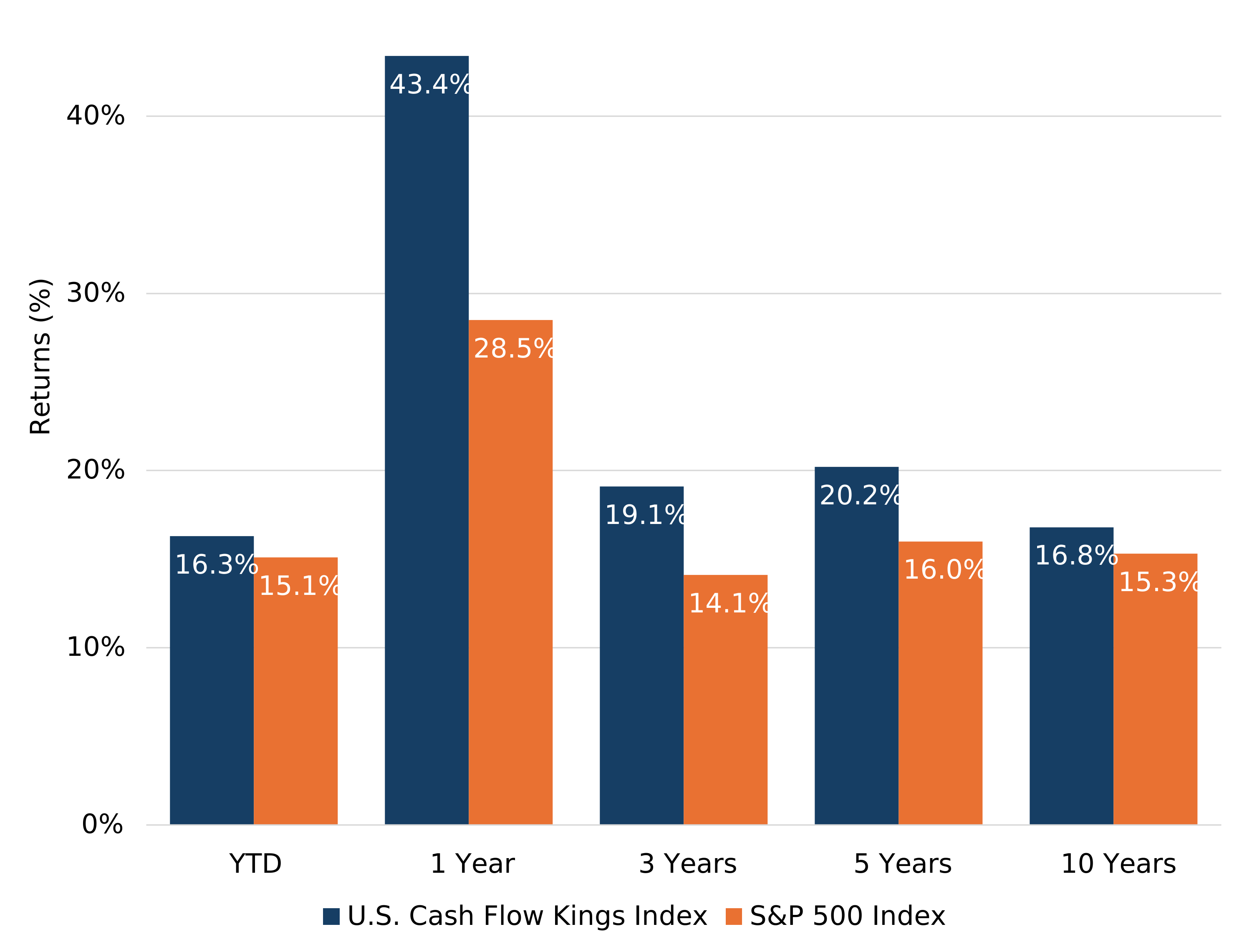
Companies with high free cash flow yields have historically outperformed the broader equity market. The Brompton Index One U.S. Cash Flow Kings Index tracks the performance of mid-to-large-capitalization U.S. equities whose issuers exhibit high free cash flow relative to their enterprise value. The Brompton Index One U.S. Cash Flow Kings Index has consistently outperformed the S&P 500 Index, as show in the chart below.
Annualized Total Return Comparison
Brompton’s Approach
Brompton U.S. Cash Flow Kings ETF (KNGU) and Brompton Canadian Cash Flow Kings ETF (KNGC) are unique rules-based ETFs in Canada designed to invest in high quality companies with high free cash flow generating abilities relative to their overall enterprise value. Companies that generate high levels of free cash flow tend to be well-established, financially stable, and have a competitive advantage in their respective industries.