
Overview of Covered Calls
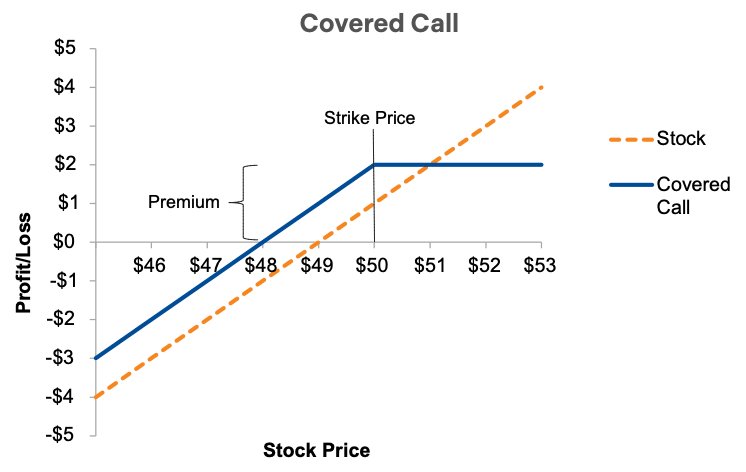
Covered call funds have become popular in recent years as investors look for higher yielding investment strategies to add to their portfolios. A covered call option strategy involves investing in a security and then selling call options on the same security. When selling call options, the investor receives a premium up front in exchange for a liability that obligates the option seller to sell the underlying security at a certain price (the “strike price”) up until a certain date at the discretion of the option buyer. This combination of a long position in a security and a short position in a call option on the same security that make up a covered call, caps the investor’s upside at the strike price in exchange for the option premium. Broken down into its components, an at-the-money covered call provides the investor with long equity exposure and short volatility exposure to the underlying security.
Benefits of Covered Calls
Covered call strategies allow a fund to generate premiums that are received when selling call options, which reduce the volatility of the portfolio and often allow the fund to pay out higher distributions than it would otherwise be able to do. Relative to a traditional long-only strategy, certain covered call strategies can have several benefits for an investor:
- Lower volatility
- Higher risk-adjusted returns over time
- Outperformance during flat markets
- Lower drawdowns during volatile markets
- Potential for higher distributions
Differences in Covered Call Strategies
When looking at covered call strategies, we believe it is important for investors to realize that not all strategies are created the same. There are several key decisions a portfolio manager must make when designing and executing an options strategy. The most notable decision is the moneyness level at which the options are written. For example, a portfolio manager could write options at the current trading price of the underlying strategy – known as an at-the-money (“ATM”) strategy – or at some price above the current trading price of the underlying security – known as an out-of-the-money (“OTM”) strategy.
Changes to various options parameters can have a significant impact on the risk/return profile of a covered call strategy. For example, simply changing the moneyness level at which calls are written will impact the amount of options premiums received, with higher premiums received for an ATM strategy relative to an OTM strategy. However, these additional premiums do not come for free, as the investor still needs to consider the -$5 -$4 -$3 -$2 -$1 $0 $1 $2 $3 $4 $5 $46 $47 $48 $49 $50 $51 $52 $53 Profit/Loss Stock Price Stock Covered Call Strike Price Premium Covered Call corresponding liability for the obligation to deliver the security at a fixed price in the future. Our sense is that investors typically believe that more premiums lead to higher distributable income; however, generating higher premiums by writing closer to the money also means sacrificing more of the upside when markets move higher, which reduces total returns.
Option Premiums ≠ Yield
In our view, the biggest misconception with respect to covered calls is that the gross option premiums received represent income or yield to the investor. While these premiums represent an immediate positive cash flow, we also need to consider the future liability that comes with selling options. To illustrate this, let’s consider the analogy of a zero-coupon bond from the perspective of its issuer. In this example, let’s assume a company issues a bond at $95 that comes due in one year at $100 and that the appropriate discount rate is 5%. This bond issuance results in an immediate positive cash flow of $95 to the company; however, this cash flow is clearly not “income” for the issuer since it comes with a corresponding liability that has a present value of $95 (i.e. $100 discounted at 5% for one year).
Writing a call option can be viewed in a similar manner to issuing a zero-coupon bond. An option seller receives an immediate positive cash flow in exchange for a future liability, with these amounts being equal at the time the option is sold. Like with the zero-coupon bond, the cash flow or gross premium generated by the option seller is not income. Different from the zero-coupon bond, the ultimate value of the option seller’s liability on the exercise date is determined based on the price of the underlying security at that time. If the price of the underlying has moved above the strike price, the option seller will be obliged to sell the position (at the strike price) below its market value. If the price has remained below the strike price, there will be no remaining liability at expiry.
In order for there to be true income or yield, the seller must have sold the option at a favourable price. In other words, the option’s implied volatility needs to be higher than the underlying security’s expected or realized volatility. Fortunately, there is well-documented evidence that equity market options tend to be systematically overpriced in the long run.
Options as an Insurance Contract and the Volatility Risk Premium
Another way to look at an option contract is to think of it as a financial insurance contract. Just as in the case of an insurance provider, an option seller brings in premiums in exchange for a liability that pays out based on certain future events, and the net profitability of this strategy depends on whether the premiums are enough to cover these eventual losses. In the case of equity markets, option sellers tend to be compensated by the volatility risk premium (“VRP”), which is the phenomenon that option-implied volatility tends to exceed realized volatility of the same underlying security over time. This concept is illustrated on the S&P 500 Index as follows:

As seen in the chart above, implied volatility in the equity market tends to be consistently higher than actual realized volatility, with the lone exception over the past 30+ years being 2008. The main theory for why the VRP exists is that option buyers tend to pay up for the “insurance” provided in the options market, and therefore options tend to trade at a premium to their theoretical value like traditional insurance. This can benefit option sellers, who may be able to capture this premium over the long run.
Covered Call Performance – Equities
Equity index covered call strategies have historically delivered superior risk-adjusted returns compared to their underlying benchmark, and depending on the strategy, have delivered returns close to those in the underlying equity market with lower volatility. This is illustrated in the following table, which shows the performance of the S&P 500 Index compared to two S&P 500 covered call indexes since their inception in 1986:
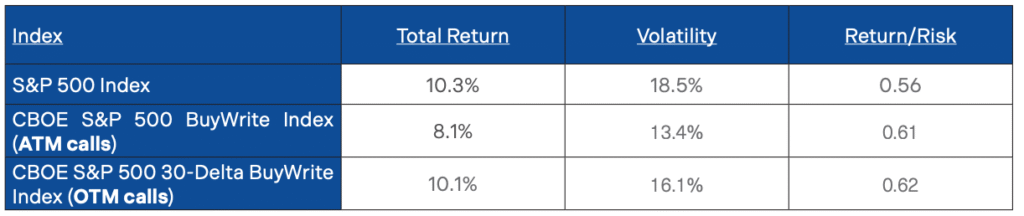
As shown in the table, covered call strategies have generated superior risk-adjusted returns. In theory, an investor could have leveraged these covered call strategies such that the volatility was the same as that in the equity market, but with higher returns therefore capturing the volatility risk premium. However, the table also shows that the at-the-money (ATM) strategy had lower absolute returns than both the out-of-the-money (OTM) strategy and the underlying index. Since the ATM strategy would have brought in the highest amount of gross option premiums, we believe the lower absolute performance clearly demonstrates our statement above that gross option premiums do not represent income or yield for an investor in a covered call strategy. In our view, total return and risk are what matter. If a portfolio manager were to run a covered call strategy where they viewed gross option premiums as “distributable yield” and paid them out to investors, then it is highly likely that the distribution would be greater than the long run total return of the strategy. This is particularly true for an ATM covered call strategy, and in this case the amount of capital in the portfolio would decline as distributions would exceed returns, all else being equal.
Covered Calls on Bonds
Over the past couple of years, we have seen the launch of several covered call strategies in both the U.S. and Canada where the underlying asset is a portfolio of long-term bonds rather than equities. , The underlying security for a few recent fund launches is the iShares 20+ Year Treasury Bond ETF (“TLT”), which is a fund that holds 20+ year U.S. treasury bonds. Similar to the CBOE S&P 500 covered call indexes above, CBOE has an index that writes monthly covered calls on TLT. In this case, the calls are written 2% OTM. The following table shows the comparative performance since the inception of the covered call index in January 2005:

Similar to the equity covered call strategies, the bond covered call strategy generated superior risk-adjusted returns, while volatility was significantly lower and total returns were slightly lower than those of the underlying asset.
How to Think About Income on Covered Call Strategies
Just as a company cannot sustainably pay out more dividends than it earns in income over the long run, an investment fund cannot continue to pay distributions that exceed the long run total return of the strategy without eventually eroding its net asset value. While future returns are mostly unknown in investing, we believe that funds whose strategy is to write ATM calls and pay out the option premiums as “yield” clearly run the risk of a declining NAV over time, as these strategies fail to consider the future liabilities that come alongside the premiums. This is particularly true for fixed income covered call strategies where the long run returns can be approximated by the underlying yield on the portfolio at the time of investment.
This does not mean that covered call strategies cannot be used for income. In our view, by reducing the volatility of the portfolio, covered calls allow the portfolio manager to be more confident in paying out higher distributions because there is less variability in the returns. However, we believe the portfolio manager must consider the long-term total return potential of the strategy when setting its distribution policy in order to avoid the risk of overpaying in the long run.
Conclusions
We believe there are several conclusions to be drawn from our analysis:
- Covered call strategies provide several benefits for an investor, in particular, lower volatility and higher risk-adjusted returns in the long run.
- The gross premiums generated by selling options should not be viewed as income, as these premiums are received in exchange for a future liability. In order for there to be true income or yield, the seller must have sold the option at a favourable price.
- Historically, equity market volatility implied by options markets tend to exceed realized volatility over time. This “volatility risk premium” can be captured by an investor in covered call strategies.
- The total return of a strategy is what matters, and investors should assess the distribution rate on any strategy to determine whether they think it is reasonable relative to the long-term total return potential of the strategy
Brompton’s Approach
Brompton’s covered call funds offer investors exposure to a portfolio of large capitalization equities and are designed to provide regular distributions, the opportunity for capital appreciation and lower volatility than would otherwise be experienced by holding the same portfolio of equities directly. By using a covered call strategy, Brompton can draw on three main sources of potential total return for the fund: (i) capital appreciation of the underlying equities in the portfolio; (ii) dividend income from the portfolio; and (iii) net premiums earned from writing call options.
As discussed above, a variety of factors can impact the risk/return profile and overall success of covered call strategies. Brompton’s portfolio management team carefully selects and manages both the underlying equity portfolio as well as the call options, while also considering how these two components might perform under various market conditions. The construction and management of the covered call option strategy is a complex and dynamic process that is difficult and costly for individual investors to replicate in their own portfolios.
Brompton takes an active approach to covered call writing with the aim of generating superior risk-adjusted returns. We adjust various parameters such as the percentage of the portfolio covered by calls and the relative moneyness based on market/volatility conditions and our investment outlook. We may write calls on a lower percentage of the portfolio in rising or low volatility markets to capture more market appreciation for the fund’s portfolio, while we may write additional premiums in declining or high volatility markets to reduce the risk of the portfolio and provide a cushion against a market decline.
Under current market conditions, Brompton typically writes covered call options that are short dated (1-2 months expiry). Writing short-term call options can increase the likelihood that the options expire without being exercised, thereby allowing new calls to be written on the same underlying securities and potentially generating more premiums. In addition, Brompton will often write out-of-the-money calls, which allow investors to participate in the upside potential of the underlying securities to a greater extent than at-the-money calls. An out-of-the-money call sets the strike price above the market price allowing the fund to capture capital appreciation upside plus the option premium.
This document is for information purposes only and does not constitute an offer to sell or a solicitation to buy the securities referred to herein. The opinions contained in this report are solely those of Brompton Funds Limited (“BFL”) and are subject to change without notice. BFL makes every effort to ensure that the information has been derived from sources believed to be reliable and accurate. However, BFL assumes no responsibility for any losses or damages, whether direct or indirect which arise from the use of this information. BFL is under no obligation to update the information contained herein. The information should not be regarded as a substitute for the exercise of your own judgment. Please read the relevant prospectus or annual information form before investing.
Commissions, trailing commissions, management fees and expenses all may be associated with exchange-traded fund investments. Please read the prospectus before investing. Exchange-traded funds are not guaranteed, their values change frequently and past performance may not be repeated.
You will usually pay brokerage fees to your dealer if you purchase or sell shares or units of the investment fund on the Toronto Stock Exchange or other alternative Canadian trading system (an “exchange”). If the shares or units are purchased or sold on an exchange, investors may pay more than the current net asset value when buying shares or units of the investment fund and may receive less than the current net asset value when selling them.
There are ongoing fees and expenses associated with owning shares or units of an investment fund. An investment fund must prepare disclosure documents that contain key information about the fund. You can find more detailed information about the fund in the public filings available at www. sedarplus.ca. Investment funds are not guaranteed, their values change frequently and past performance may not be repeated.
Information contained in this document was published at a specific point in time. Upon publication, it is believed to be accurate and reliable, however, we cannot guarantee that it is complete or current at all times. Certain statements contained in this document constitute forward-looking information within the meaning of Canadian securities laws. Forward-looking information may relate to matters disclosed in this document and to other matters identified in public filings relating to the funds, to the future outlook of the funds and anticipated events or results and may include statements regarding the future financial performance of the funds. In some cases, forward-looking information can be identified by terms such as “may”, “will”, “should”, “expect”, “plan”, “anticipate”, “believe”, “intend”, “estimate”, “predict”, “potential”, “continue” or other similar expressions concerning matters that are not historical facts. Actual results may vary from such forward-looking information. Investors should not place undue reliance on forward-looking statements. These forwardlooking statements are made as of the date hereof and we assume no obligation to update or revise them to reflect new events or circumstances.