
Artificial intelligence (AI) is based on the assumption that the process of human thought can be mechanized and, as a result, AI applications can perform some tasks that normally require human intelligence. Many ponder whether machine intelligence can surpass human intelligence. Scientists call this AI singularity, and some believe this could happen within the next century. Perhaps full-blown AI development could create deus ex machina (“god from the machine”).
The AI spectrum is very broad but can be classified into several categories – natural language processing, optimization, rules-based, robotics and machine learning. Machine learning provides computers with the ability to learn without being explicitly programmed. Machine learning algorithms leverage large data sets to discover hidden patterns and learn to adapt and grow when exposed to new data/conditions, without human intervention.
We are entering another inning in the AI revolution given the pace of technological advancements, development of AI applications and machine learning algorithms. Improvements in silicon technology has enabled computer chips to mimic the brain’s structure and processing capability. In addition, data management and storage techniques continue to improve and be optimized, which bodes well for training machine learning algorithms. Many machine learning libraries and standardized algorithms are now available through the opensource community, which provides an open and collaborative method to maintain and incrementally improve software. Cloud computing creates a sandbox for AI development, which facilitates rapid prototyping of AI applications, offers access to large datasets, and lowers cost. Many large cloud providers now offer machine learning-as-a-service.
Today AI systems are becoming more sophisticated and one step closer to competing with human intelligence. We’ve seen computers beat world chess champions (IBM Deep Blue vs Gary Kasparov) and Go champions (Google’s AlphaGo vs Ke Jie). Interestingly, AlphaGo leveraged actual game play (with human opponents) as well as games played against itself to refine its learning capabilities in the Go game. Recently a new class of AI applications called large language models were developed, with more conversational capabilities versus traditional chatbots. Last year both LaMDA (Google) and ChatGPT (Open AI) were able to pass the Turing test. This test, which was introduced by mathematician Alan Turing in the 1950s, suggests that machines can think if their written replies to questions could not be distinguished from a human respondent. LaMDA was able to convince an engineer it was conscious and sentient.
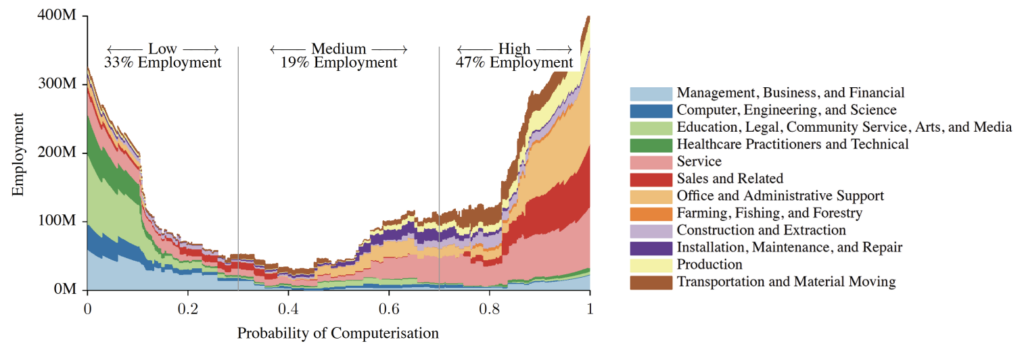
With the proliferation of AI, many are concerned about machines taking over human jobs. Almost 50% of jobs are susceptible to automation over the long term, according to various industry studies (Frey and Osborne, OECD, World Economic Forum, McKinsey) – see figure 1 below. While there remains much debate about the extent to which robots will take over jobs, McKinsey analysis also suggests that only 5% of global occupations can be automated in their entirety, with 60% of those having at least 30% of automatable activities using current AI technology. We believe that AI will in the near term co-exist with humans in the workforce, augmenting functionality, improving productivity, and realigning the labour force towards more highly skilled jobs. Historically, innovation has redefined jobs and created new opportunities. As an example, the industrial revolution drove significant productivity improvements; the computing revolution created more jobs involving the use or development of computers; and the Internet boom led to business models and jobs that didn’t exist previously.
Figure 1 – Artificial Intelligence Disruption on Employment
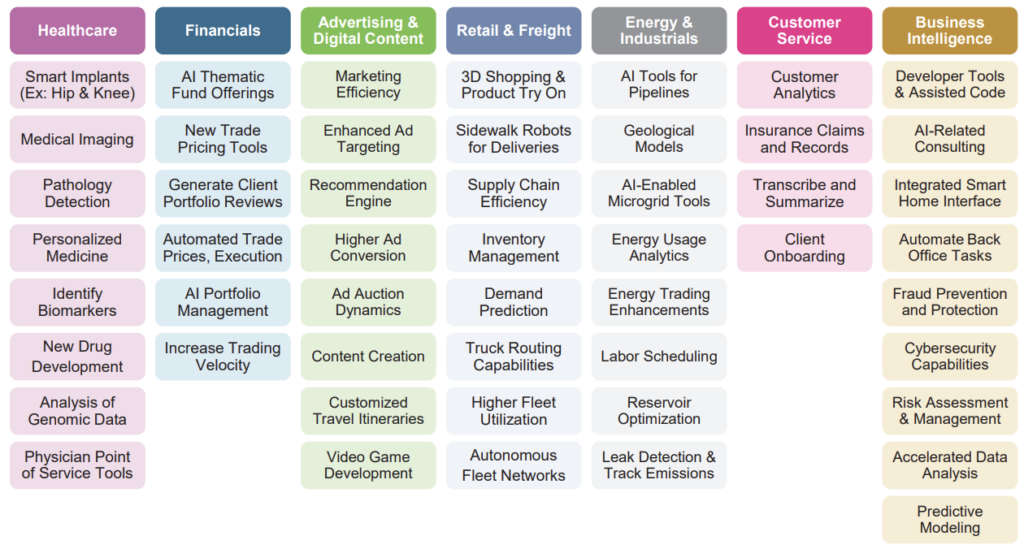
AI has the propensity to disrupt the global economy over the longer term and drive the next leg of growth. AI could contribute up to $15.7 trillion to the global economy in 2030, more than the current output of China and India combined, according to a report by PwC1 . AI transformation is three pronged: 1) automation – creation of a new virtual workforce; 2) augmentation – AI can augment human labour; and 3) diffusion – AI innovations could drive transformational changes in the economy (new industries, business models etc.). Figure 2 below illustrates examples of how AI can drive innovation and transformational change across the economy.
Figure 2 – Artificial Intelligence Driving Innovation Across Industries
Fund in Focus
Brompton Tech Leaders Income ETF (TLF, TLF.U) provides investors with actively managed exposure to a portfolio of equity securities of large capitalization, primarily North American-listed Technology Companies. TLF currently has exposure to AI technology through holdings in semiconductor companies, mega tech and large enterprise software companies. Leading chip manufacturers and related semiconductor companies provide the silicon building blocks that make AI possible. Mega tech companies have a significant number of AI patents, offer machine learning-as-a-service and can leverage their large userbase in driving AI adoption. Large enterprise software companies have begun to offer intelligent decision-making capabilities in their software as well as intelligent automation. We believe the AI revolution will provide structural growth tailwinds for many tech companies over the long-term.
1 PwC’s Global Artificial Intelligence Study: Sizing the Prize, 2017.
This document is for information purposes only and does not constitute an offer to sell or a solicitation to buy the securities referred to herein. The opinions contained in this report are solely those of Brompton Funds Limited (“BFL”) and are subject to change without notice. BFL makes every effort to ensure that the information has been derived from sources believed to be reliable and accurate. However, BFL assumes no responsibility for any losses or damages, whether direct or indirect which arise from the use of this information. BFL is under no obligation to update the information contained herein. The information should not be regarded as a substitute for the exercise of your own judgment. Please read the prospectus before investing.
Commissions, trailing commissions, management fees and expenses all may be associated with exchange-traded fund investments. Please read the prospectus before investing. Exchange-traded funds are not guaranteed, their values change frequently and past performance may not be repeated.
Information contained in this document was published at a specific point in time. Upon publication, it is believed to be accurate and reliable, however, we cannot guarantee that it is complete or current at all times. Certain statements contained in this document constitute forward-looking information within the meaning of Canadian securities laws. Forward-looking information may relate to matters disclosed in this document and to other matters identified in public filings relating to the funds, to the future outlook of the funds and anticipated events or results and may include statements regarding the future financial performance of the funds. In some cases, forward-looking information can be identified by terms such as “may”, “will”, “should”, “expect”, “plan”, “anticipate”, “believe”, “intend”, “estimate”, “predict”, “potential”, “continue” or other similar expressions concerning matters that are not historical facts. Actual results may vary from such forward-looking information. Investors should not place undue reliance on forward-looking statements. These forwardlooking statements are made as of the date hereof and we assume no obligation to update or revise them to reflect new events or circumstances.