
Over the last 20 months, interest rates have been rising as central banks, including the Bank of Canada, have raised short term rates to battle inflation, while longer term bond yields have risen in response. This has put pressure on dividend paying stocks such as those in the Utilities, Real Estate, Telecommunications, Financials, and other sectors. However, as it becomes increasingly clear that this hiking cycle is over, we think it’s time for these stocks to stage a comeback.
What’s Happening with Rates?
The 5-year Canadian government bond yield peaked in October 2023 and has since been falling. Inflation is coming under control (CPI at 3.1% in November1), the economy is slowing (Q3 2023 Real GDP at -1.1%, projected at 0.2% for each of Q1 and Q2 20242), and the unemployment rate is rising (projected to be at 6.5% by year end 2024 vs 5.5% currently3). Additionally, approximately 45% of outstanding Canadian mortgages are up for renewal in 2024 & 20254, and it looks increasingly likely that the Bank of Canada is at the end of the rate hiking cycle and could start cutting rates in 2024.
Dividend Stocks Have Underperformed as Rates Have Risen
The chart below illustrates the message. The orange line shows 5-year Government of Canada bond yield on an inverted scale, while the blue line shows the performance of the TSX Dividend Aristocrat Index relative to the TSX Composite Index over the last year. As you can see, dividend growth stocks have underperformed the market as rates have risen.
TSX Dividend Aristocrats vs. 5-year Bond Yield
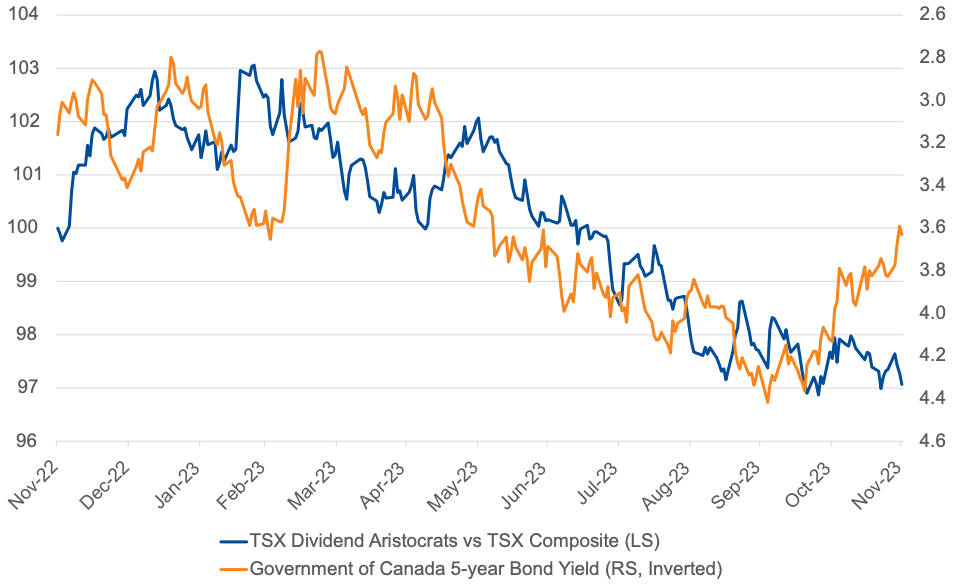
This typically makes sense, as investors who buy stocks with a high dividend yield, are buying them for the income they generate, and their relative stability compared to high growth stocks. However, when Government of Canada yields rise (as it did from ~0.4% at the end of 2020, to a high of 4.3% in October 20235 on the 5-year), investors had a safer alternative to dividend stocks.
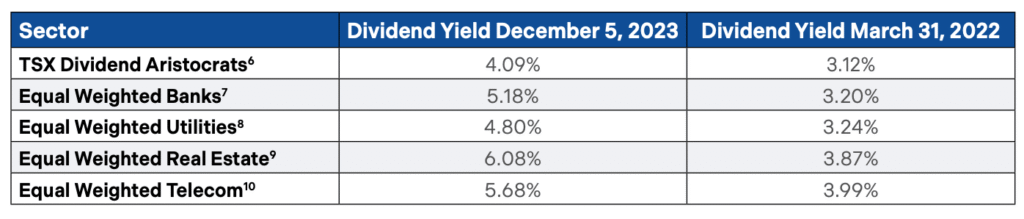
Logically, investors sell their dividend paying stocks and move their money into higher yielding and safer government bonds. This rotation out of dividend paying stocks has pushed up the yields on sectors that have a higher proportion of dividend paying stocks, as illustrated in the chart below which compares how yield sensitive dividend equities have reacted to the sharp rise in rates over the past 20 months:
Looking Forward
Despite this relationship holding true until rates peaked in early October, there has been a divergence between rates that have continued to decline and dividend stocks that have not recovered yet. We believe that peaking rates should mark the bottom for these high dividend stocks, and that they should outperform into 2024. The higher dividend yields on these stocks, coupled with the falling yields on government bonds once again make the dividend stocks an attractive investment opportunity.
1 Source: Bloomberg: ECO
2 Source: Bloomberg: ECFC
3 Source: Bloomberg: ECFC
4 https://vancouver.citynews.ca/2023/11/10/canada-mortgage-interest-rates-renewal-shock/
5 Bloomberg: GCAN5YR Index6Bloomberg: CDZ CN Equity
7Bloomberg: SOLCBEW Index
8Bloomberg: SOLCUEW Index
9Bloomberg: SOLCREW Index
10Bloomberg: STTELS IndexThis document is for information purposes only and does not constitute an offer to sell or a solicitation to buy the securities referred to herein. The opinions contained in this report are solely those of Brompton Funds Limited (“BFL”) and are subject to change without notice. BFL makes every effort to ensure that the information has been derived from sources believed to be reliable and accurate. However, BFL assumes no responsibility for any losses or damages, whether direct or indirect which arise from the use of this information. BFL is under no obligation to update the information contained herein. The information should not be regarded as a substitute for the exercise of your own judgment. Please read the relevant prospectus or annual information form before investing.
Commissions, trailing commissions, management fees and expenses all may be associated with exchange-traded fund investments. Please read the prospectus before investing. Exchange-traded funds are not guaranteed, their values change frequently and past performance may not be repeated. You will usually pay brokerage fees to your dealer if you purchase or sell shares or units of an investment fund on the Toronto Stock Exchange or other alternative Canadian trading system (an “exchange”). If the shares or units are purchased or sold on an exchange, investors may pay more than the current net asset value when buying shares or units of an investment fund and may receive less than the current net asset value when selling them.
There are ongoing fees and expenses associated with owning shares or units of an investment fund. An investment fund must prepare disclosure documents that contain key information about the fund. You can find more detailed information about a fund in the public filings available at www.sedarplus.ca. Investment funds are not guaranteed, their values change frequently and past performance may not be repeated.
Information contained in this document was published at a specific point in time. Upon publication, it is believed to be accurate and reliable, however, we cannot guarantee that it is complete or current at all times. Certain statements contained in this document constitute forward-looking information within the meaning of Canadian securities laws. Forward-looking information may relate to matters disclosed in this document and to other matters identified in public filings relating to the funds, to the future outlook of the funds and anticipated events or results and may include statements regarding the future financial performance of the funds. In some cases, forward-looking information can be identified by terms such as “may”, “will”, “should”, “expect”, “plan”, “anticipate”, “believe”, “intend”, “estimate”, “predict”, “potential”, “continue” or other similar expressions concerning matters that are not historical facts. Actual results may vary from such forward-looking information. Investors should not place undue reliance on forward-looking statements. These forwardlooking statements are made as of the date hereof and we assume no obligation to update or revise them to reflect new events or circumstance.