
May 25, 2026 |

Funds in focus: Brompton North American Financials Dividend ETF
The U.S. financial sector is firing on multiple cylinders. After years of depressed dealmaking, a shuttered IPO window, and a punishing interest rate cycle, the capital markets engine has roared back to life. First quarter earnings from the largest U.S. banks confirmed what many investors had been anticipating: investment banking fees, trading revenues, and advisory mandates are surging, creating a powerful and durable tailwind for financials that we believe will persist through the balance of 2026 and beyond.
The M&A Renaissance: Resilient Pipelines, Broadening Activity
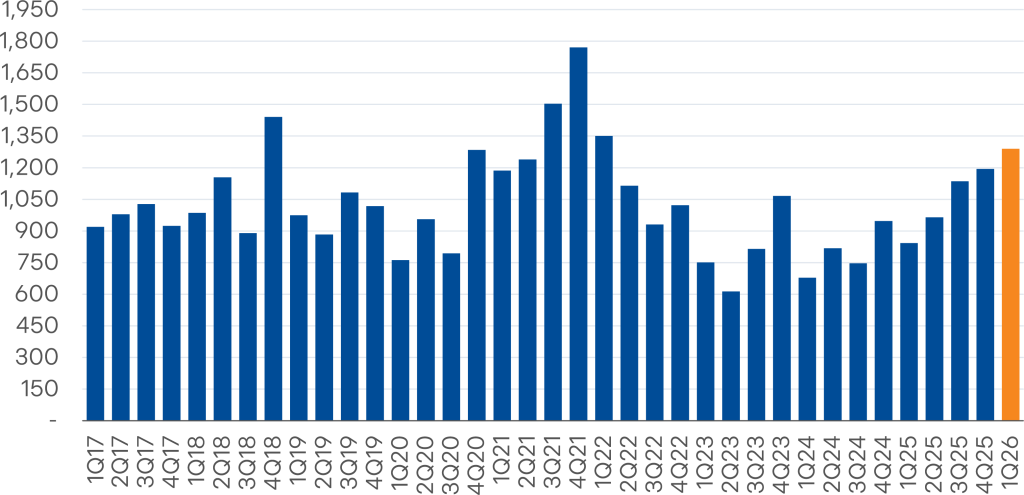
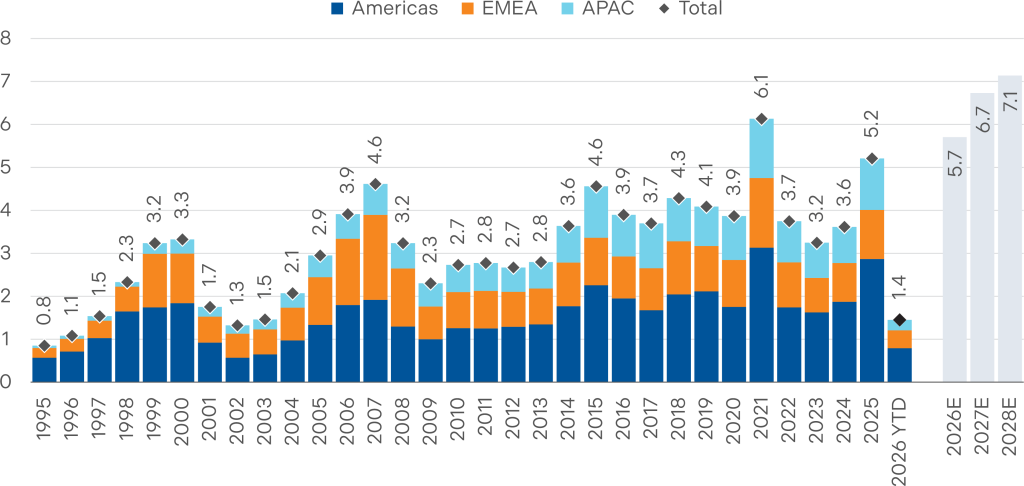
M&A activity has accelerated in recent quarters, while regulatory approval times have fallen to less than five months. The return of M&A that began in 2024 accelerated sharply in 2025, and the momentum has carried into 2026. The first quarter of 2026 marked a fifth consecutive quarter of global announced deal volume growth on a year-over-year basis, according to Morgan Stanley, with announced volumes rising 22% y/y and completions surging 53% y/y.1 Large deals over US$10B in size showed particular strength, with announcements increasing 42% y/y – the highest mix in six years.1
|
|
| Regionally, the Americas accounted for 55% of announced volumes in Q1 2026, while the pipeline remains diversified across multiple sectors. Software represented the largest share of Q1 2026 announced volumes at 20% of total, followed by healthcare at 12% and utilities/energy at 10%. Despite concerns about software and AI disruption, software M&A announcements increased 48% y/y in Q1 2026, suggesting deal activity in this key sector is resilient.1 |
|
|
We anticipate M&A volumes will continue their upward trajectory, driven by a favorable regulatory environment, the need for sponsors (ie. private equity firms) to transact, multiple years of pent-up demand, and open funding markets.
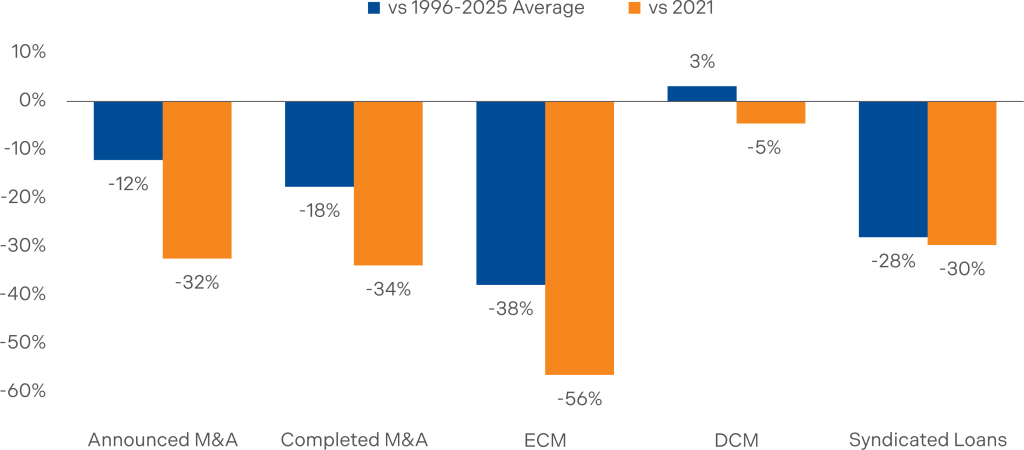
Credit Markets Wide Open: Record Investment Grade Issuance Fueling DealsU.S. credit markets are providing critical support for the capital markets cycle. Despite geopolitical volatility in March that briefly paused issuance, investment grade issuance reached a record US$676 billion in Q1 2026, up 15% y/y according to Morgan Stanley.1 The March disruption produced the largest single-day IG issuance total on record at US$66 billion on March 10, as companies rushed back to market once stability returned. Crucially, acquisition-related debt issuance is picking up meaningfully. According to Pitchbook data, 18% of Investment Grade deals in Q1 2026 were tagged to M&A-related purposes, up from 14% at the same point in 2025.1 If this trend continues, 2026 would see the highest share of acquisition-related use of proceeds since 2019. Open and accommodative credit markets are a necessary precondition for a sustained M&A cycle, and this box is firmly checked. Blockbuster IPOs on the Horizon: Expected to Drive Record FeesThe anticipated wave of high-profile technology IPOs represents another significant tailwind for the capital markets-oriented financials. Several of the most valuable private companies in the world – including OpenAI, Anthropic, Databricks, Stripe, Klarna, and SpaceX – are widely expected to pursue public listings over the coming 12–24 months, with some already in advanced preparation stages. These are not ordinary IPOs; the sheer scale of these offerings, many of which carry private market valuations in the tens or even hundreds of billions of dollars, would generate substantial underwriting, advisory, and trading fees for investment banks that lead/manage them. Beyond the direct fee revenue, marquee IPOs of this caliber tend to catalyze broader market activity: they attract capital flows into equities, stimulate secondary trading volumes, and create a halo effect that encourages other private companies and their sponsor backers to accelerate their own IPO timelines. With the IPO market already expected to see issuance rise approximately 25% globally in 2026 and sponsor-related IPOs potentially accounting for 30–35% of total activity, the addition of several “must-own” generational technology listings could push capital markets revenues meaningfully above current consensus expectations – a scenario that is not yet fully reflected in bank stock valuations.1 Deregulation: Unlocking Capital and Catalyzing ConsolidationAs we detailed in our August 2025 insight, “A New Era for U.S. Banks,” the regulatory pendulum has swung decisively in favor of the banking sector. The confirmation of Fed Governor Michelle Bowman as Vice Chair for Supervision signaled a broad deregulatory agenda. M&A activity’s pickup was also partly due to an accelerated regulatory approval agenda as approval times have fallen to less than five months, down from 12-18 month under the stricter Biden-era framework. Still Below Trend: Room for Capital Markets to GrowDespite the strong recovery, capital markets activity remains below historical norms. Morgan Stanley’s analysis shows that Q1 2026 annualized announced global M&A volumes as a percentage of U.S. nominal GDP are running 12% below the 1996-2025 average, and completed volumes are 18% below average.1 Equity capital markets (ECM) volumes are 38% below average, while debt capital markets (DCM) volumes are slightly above. This suggests meaningful room for further improvement before activity even returns to historical trend levels, let alone the 2021 cycle peak. |
|
|
Outlook: Multiple Tailwinds ConvergingWe believe U.S. financials are entering a period of unusually favorable conditions. The convergence of a capital markets revival, a pro-business deregulatory environment, accelerating bank consolidation, record credit market issuance, generational IPOs on the horizon, and a supportive monetary policy backdrop create multiple, mutually reinforcing tailwinds. The peak of regulatory pressure has passed, and we believe these structural changes have the potential to serve as a multi-year catalyst for bank stock performance, making the U.S. financials sector one of the most compelling investment opportunities in 2026. Brompton’s ApproachAt Brompton, we have decades of experience investing in Financials. Investors can get exposure to the capital market tailwind theme through Brompton North American Financials Dividend ETF (BFIN) which currently has significant exposure to U.S banks. BFIN provides monthly distributions and the opportunity for capital appreciation through investing in an actively managed, diversified portfolio of North American financial services companies. We also use an actively managed call writing overlay to earn option premiums and lower the overall volatility of returns associated with owning a portfolio of equity securities. |

Maggie Meng
Senior Investment Analyst
Maggie Meng has nearly a decade of experience in the financial industry and is a Senior Investment Analyst with Brompton Funds. Since joining Brompton in 2015, Ms. Meng has held progressively senior roles and she currently specializes in equity security selection with a focus on global utilities, real estate, industrials and telecommunications.