Crude Awakening: Navigating the 2026 Energy Shock

April 10, 2026

By: Laura Lau                                                                                                                 View PDF

Funds in focus: Brompton Enhanced Multi-Asset Income ETF (BMAX), Brompton Energy Split Corp. (ESP)

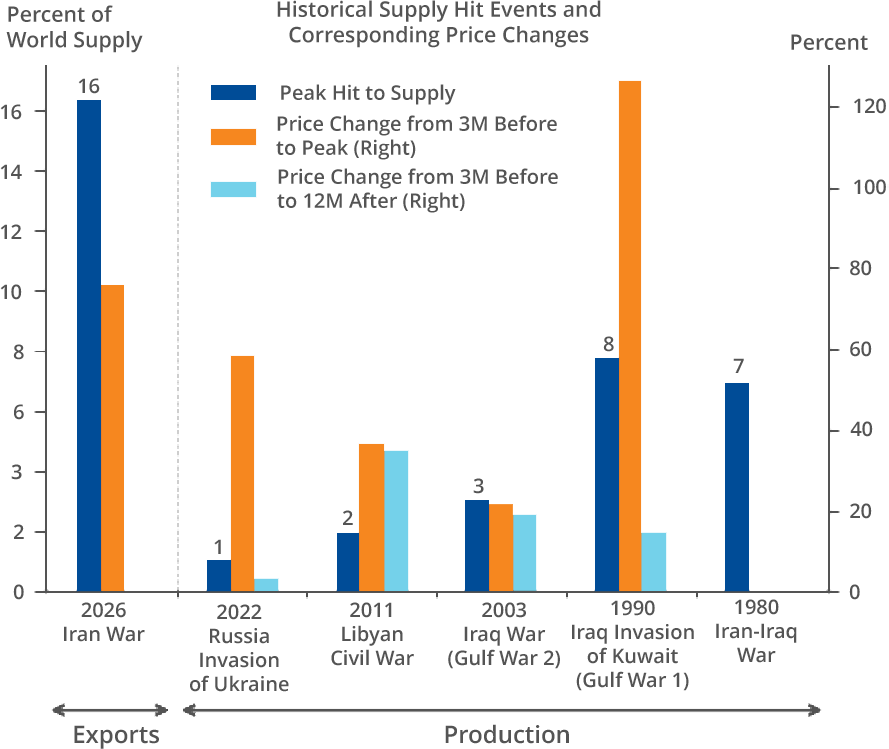
The conflict in Iran is a fluid situation, but already it is the worst supply disruption to hit energy markets as shown in the chart below.

Largest Oil Supply Disruption

Source: Goldman Sachs Research, March 22, 2026.

What makes this shock unique is 1) shutting down the Strait of Hormuz which ships approximately 20% of the world’s oil, 20% of the world’s liquefied natural gas (LNG), 33% of world’s nitrogen fertilizer.1; and 2) the extensive damage to over 40 energy assets including ports, refineries, LNG plants, processing facilities, and gas fields.2

With the damage to oil infrastructure, it would take months to restore pre-war production. In the case of LNG, Qatar expects their damaged plant to be fully operational in 2-3 years. As a result, we expect to see higher energy prices for longer.3

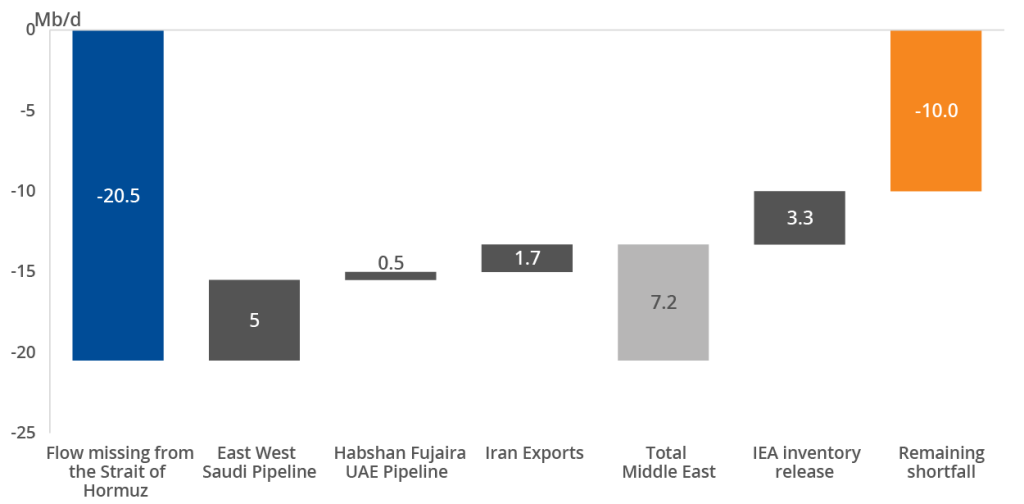
Although 20 Mbbl/d was shipped through the Strait of Hormuz, we believe that after re-routing oil to other ports, with Iran still exporting oil, and other mitigation measures such as releasing strategic petroleum reserves and demand rationing, the true shortfall is likely around 10 Mbbl/d, which would still be the largest supply disruption in history. As shown in the chart below.

Strait of Hormuz Shortfall

Source: UBS Research. March 13, 2026.

Note that the 5 M b/d of flows through the East West Saudi pipeline could be at risk with the Houthis entering the conflict since they have attacked this pipeline and shipping route in the past. The limited inventories in jet fuel, diesel, natural gas, LPG for cooking are being depleted forcing rationing and pushing up prices around the world, particularly in Asia, Europe and emerging markets.

The big question is how long could this disruption last? As of April 7, 2026, a two week ceasefire has been declared to start negotiations. The demands and goals of Iran and US/Israel appear very far apart. Iran wants reparations and guarantees that the US and Israel will not attack again in the future. The US goal to ensure Iran cannot produce nuclear weapons, which is difficult to prove without searching a large country with boots on the ground. The danger is if the war escalates with the US blockading and/or occupying Kharg Island which exports 90% of Iran’s crude oil. The US is sending additional ground troops which may be necessary to secure the Iranian side of the Strait of Hormuz to allow safe passage of vessels. This could lead to even more attacks on energy infrastructure in the Middle East. Currently Iran is controlling which ships are allowed to transit the Strait of Hormuz. The number of ships have slowed down to a trickle with certain ships from countries such as China and India being allowed passage including tankers of Iranian crude. It is possible that more vessels will be allowed through the Strait over time by paying Iran a toll.

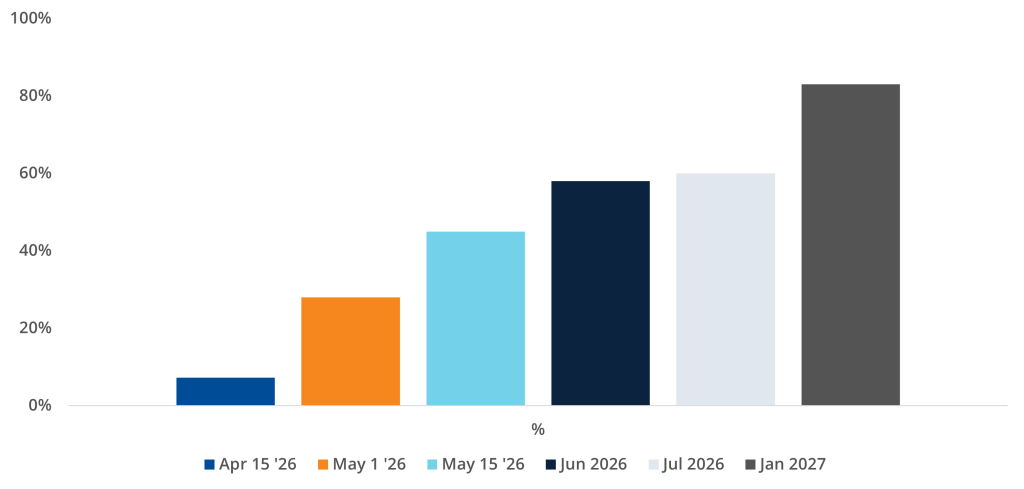
As of April 8, 2026, prediction market, Kalshi, predicts the probability of when the traffic in the Strait of Hormuz will return back to normal.

When will Traffic in the Strait of Hormuz Return to Normal?

Source: Kalshi, Brompton Funds. Data retrieved April 8, 2026

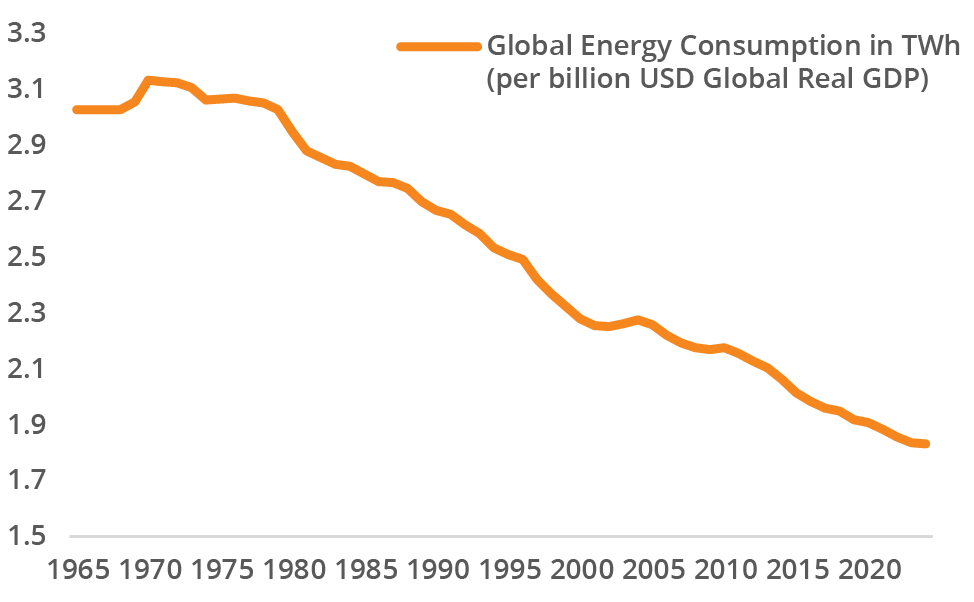
What does this mean for economic growth? The good news is the global economy is less sensitive to energy costs than previous oil shocks as shown in the chart below.

Energy Intensity of the Global Economy

Source: Societe Generale Cross Asset Research, March 4, 2026.

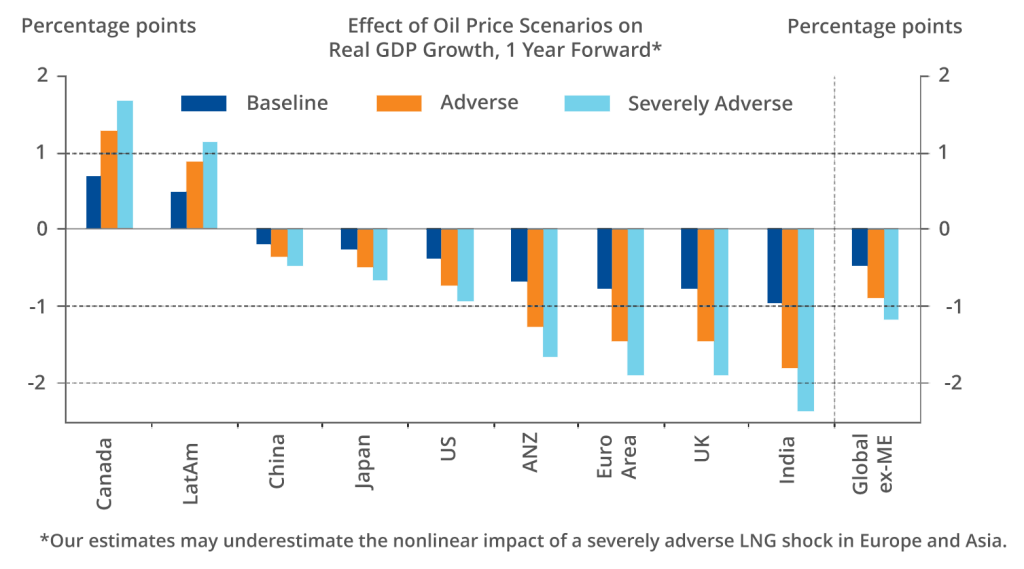
According to Goldman Sachs, their baseline scenario is that Brent oil spikes to $110/barrel and then settles down to $80 for the rest of the year. In an adverse scenario, oil would spike to $140/barrel and settle down to $90 by the end of the year. In their severely adverse case scenario, oil would spike to $160 and settle down to $100 by the end of the year.4 With energy infrastructure damaged, coupled with petroleum inventories being depleted, Brompton expects long-term prices to be higher than before the conflict. In each of these cases, the change in GDP growth is forecasted in the chart below.

As net energy exporters, Canada and Latin America are in relatively better positions. Even in the worst case scenario, US growth would drop 1% from the current consensus of 2.4% in 2026 and 2% in 2027.5

Sensitivity of Higher Energy Costs to Global Growth

Source: Goldman Sachs Economics Research, March 23, 2026.

Even in the worst case scenario, the US economy would still be growing. However, the fear of stagflation (higher inflation and slow growth/recession) typically shows up in market weakness. Earnings will likely need to be revised lower with higher energy prices spreading inflation throughout the economy. For the European Area, GDP growth was projected to be 1.2% and 1.4% for 2026 and 2027 respectively. Since Europe is more vulnerable to higher energy prices, a prolonged conflict is more likely to push the continent into recession.6

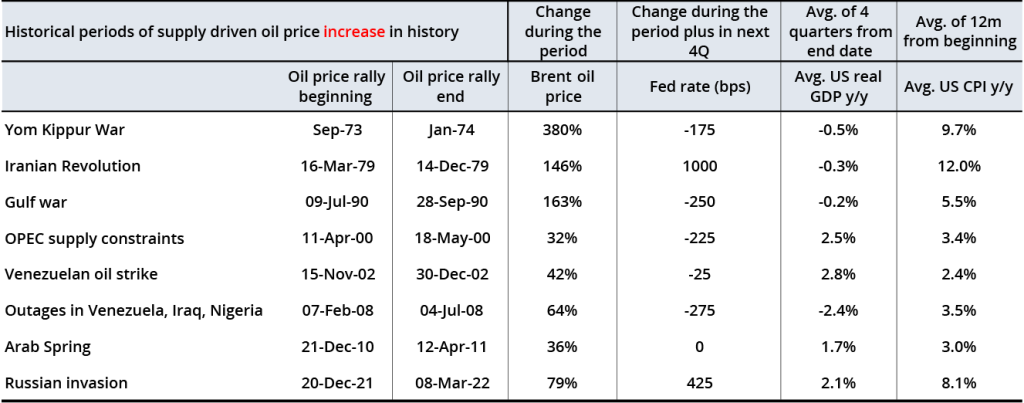
The other concern is whether central banks will stop decreasing interest rates and start hiking rates due to higher inflation. Central banks typically increase rates to cool down an overheated economy. Since inflation is being caused by energy supply issues that are transient, the central banks will likely be cautious in making any changes to benchmark rates. In fact, during the 1970s to early 1990s, the U.S. Federal Reserve (Fed) was cutting rates. As shown in the table below, the Fed only hiked interest rates in the 1979 Iranian Revolution and in the 2022 Russia-Ukraine conflict when inflation was close to 10%. If the Fed believed the US economy was likely to go into recession, the Fed would more likely cut rather than hike rates. Traditionally, the European Central Bank has been more willing to increase rates during inflation shocks.

Source: UBS Research. March 13, 2026.

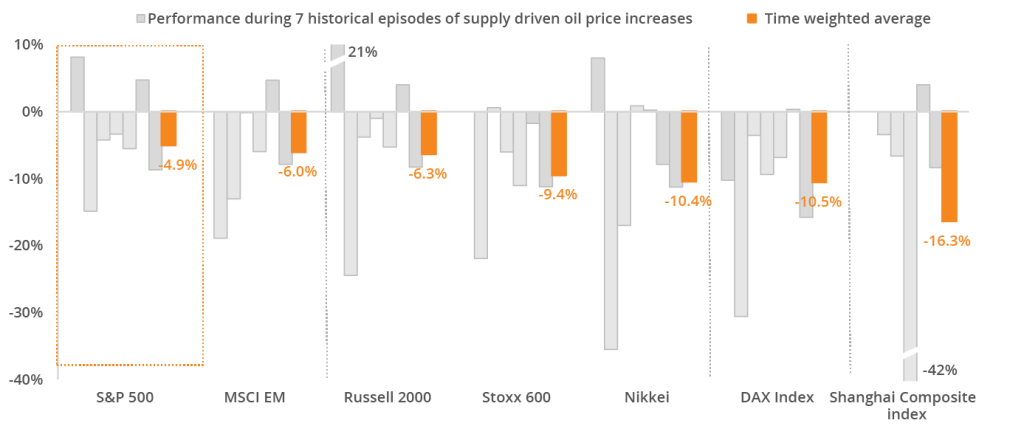
What happened to stock markets in previous oil shocks? Looking at seven historical episodes of the Iranian Revolution, Gulf War, OPEC supply constraints, Venezuelan oil strike, outages in Venezuela, Iraq & Nigeria, Arab Spring and the Russian invasion of Ukraine, the table below shows the average decline.

Source: UBS Research. March 13, 2026.

Drawdowns have already exceeded the average time-weighted averages of previous oil stocks. For instance, S&P has already drawn down nearly 9% versus a maximum decline of around 15% during the First Gulf War. Since Europe and Japan import more energy, European Stoxx 600 Index and Japan Nikkei Index are down 9.6% and 12.4% respectively.7

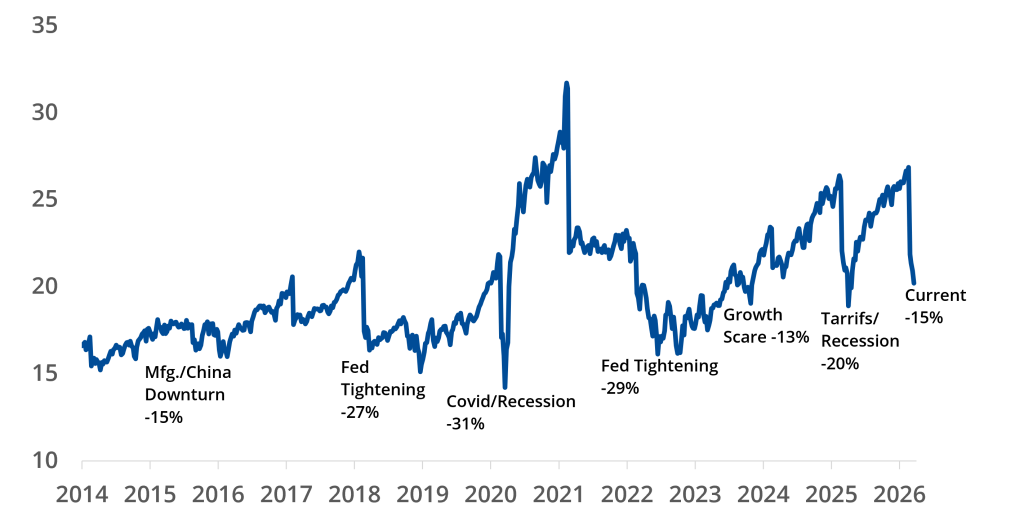
In terms of valuations, the P/E for S&P 500 declined 15% as shown in the chart below.

Sensitivity of Higher Energy Costs to Global Growth

Source: Bloomberg, as of March 20, 2026.

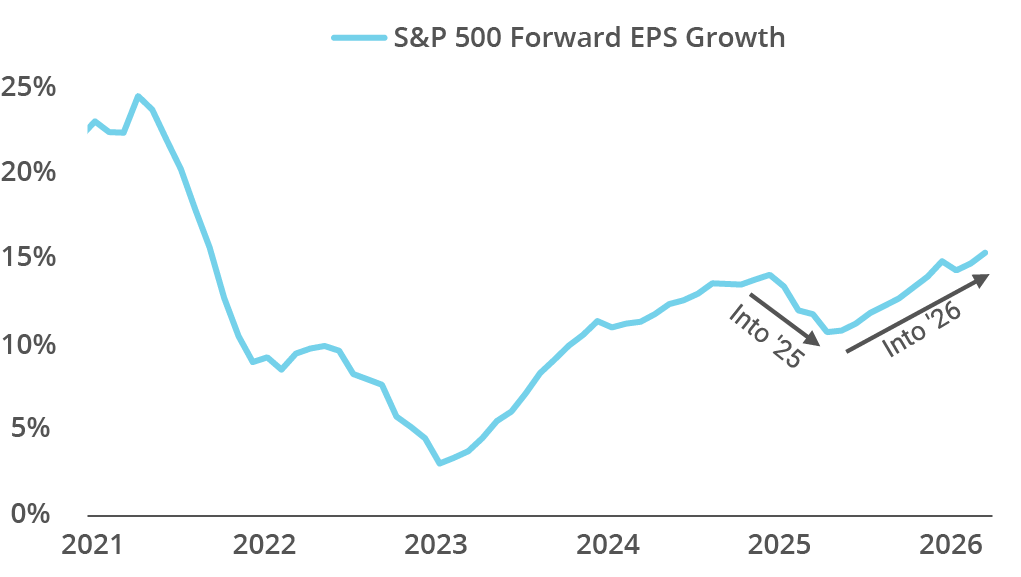
This is unusual since earnings expectations for the S&P 500 are still going up as shown in the chart below.

S&P 500 Earnings Still Growing

Source: Morgan Stanley Research, March 16, 2026.

Prior to this conflict, the US economy was accelerating with the stimulus of the One Big Beautiful Bill. The impact on the world economy will depend on the ability to open up the Strait of Hormuz. We believe normal flows will resume in a timeframe in which the US will avoid a recession, particularly since the country is a net exporter of oil. Markets are driven by earnings which should continue to grow this year so the best way to navigate this energy crisis is to stay the course and invest in a diversified portfolio of quality companies. We believe this is a correction within a secular bull market.

Brompton’s Approach

Periods of global uncertainty can be challenging for investors to navigate. Brompton Enhanced Multi-Asset Income ETF (BMAX) takes a multi-asset approach, combining a variety of investment strategies, diversified by geography, sector and asset class into one ETF built to perform across a range of market conditions. BMAX’s fixed income and low volatility holdings offer stability, while global equity investments in areas such as technology and AI infrastructure, maintain exposure to growth opportunities.

For investors seeking to benefit from higher energy prices and a renewed global focus on energy security, Brompton Energy Split Corp. Class A shares (ESP) offer leveraged exposure to an actively managed portfolio of primarily dividend-paying global energy companies for enhanced capital appreciation potential and monthly cash distributions.

1 How Much of the World’s Shipping & Oil Goes Through the Strait of Hormuz? 2025 vs 2026 Percentages of Global Supply | Speed Commerce, March 23rd, 2026; Gulf fertilizer plants go dark as Iran war chokes global supply ahead of spring planting | The Western Producer, March 17, 2026.

2 Over 40 Middle East Energy Assets ‘Severely Damaged’ by War, IEA Says – Bloomberg, March 22, 2026; Here’s a List of Energy Infrastructure Damaged in Iran War – Bloomberg, March 25, 2026.

3 Goldman Sachs Research, March 20, 2026.

4 Goldman Sachs Commodities Research, March 22, 2026. 

5 Goldman Sachs Economics Research, March 23, 2026.

6 ECB staff macroeconomic projections for the euro area, March 2026.

7 Bloomberg, as of March 30, 2026.

8 Returns are for the periods ended March 31, 2026 and are unaudited. BMAX inception date October 18, 2022. The table shows the fund’s compound returns for each period indicated. Past performance does not necessarily indicate how the fund will perform in the future. The information shown is based on Net Asset Value per unit or share and assumes that distributions made by the fund on its units or shares during the periods shown were reinvested at Net Asset Value per unit or share in additional units or shares of the respective fund.

9 Distribution rate is based on March 31, 2026 closing market price. Source: LSEG Workspace. For ESP, no distributions will be paid on the Class A Shares if (i) the distributions payable on the preferred shares are in arrears, or (ii) in respect of a cash distribution, after the payment of a cash distribution by ESP the Net Asset Value per Unit would be less than $15.00.

10 The 5-year return for ESP not determinable, as the comparative Net Asset Value per class A share was $0.00.

This document is for information purposes only and does not constitute an offer to sell or a solicitation to buy the securities referred to herein. The opinions contained in this report are solely those of Brompton Funds Limited (“BFL”) and are subject to change without notice. BFL makes every effort to ensure that the information has been derived from sources believed to be reliable and accurate. However, BFL assumes no responsibility for any losses or damages, whether direct or indirect which arise from the use of this information. BFL is under no obligation to update the information contained herein. The information should not be regarded as a substitute for the exercise of your own judgment. Please read the prospectus or annual information form before investing.

Commissions, trailing commissions, management fees and expenses all may be associated with exchange-traded fund investments. Please read the prospectus before investing. The indicated rates of return are the historical annual compounded total returns including changes in unit value and reinvestment of all distributions and does not take into account sales, redemption, distribution or optional charges or income tax payable by any securityholder that would have reduced returns. Exchange-traded funds are not guaranteed, their values change frequently and past performance may not be repeated. You will usually pay brokerage fees to your dealer if you purchase or sell shares of ESP on the Toronto Stock Exchange or other alternative Canadian trading system (an “exchange”). If the shares are purchased or sold on an exchange, investors may pay more than the current net asset value when buying shares of the investment fund and may receive less than the current net asset value when selling them.

There are ongoing fees and expenses associated with owning shares of an investment fund. An investment fund must prepare disclosure documents that contain key information about the fund. You can find more detailed information about ESP in the public filings available at www.sedarplus.ca. The indicated rates of return are the historical annual compounded total returns including changes in share value and reinvestment of all distributions and do not take into account certain fees such as redemption costs or income taxes payable by any securityholder that would have reduced returns. Investment funds are not guaranteed, their values change frequently and past performance may not be repeated.

Information contained in this document was published at a specific point in time. Upon publication, it is believed to be accurate and reliable, however, we cannot guarantee that it is complete or current at all times. Certain statements contained in this document constitute forward-looking information within the meaning of Canadian securities laws. Forward-looking information may relate to matters disclosed in this document and to other matters identified in public filings relating to the funds, to the future outlook of the funds and anticipated events or results and may include statements regarding the future financial performance of the funds. In some cases, forward-looking information can be identified by terms such as “may”, “will”, “should”, “expect”, “plan”, “anticipate”, “believe”, “intend”, “estimate”, “predict”, “potential”, “continue” or other similar expressions concerning matters that are not historical facts. Actual results may vary from such forward-looking information. Investors should not place undue reliance on forward-looking statements. These forward-looking statements are made as of the date hereof and we assume no obligation to update or revise them to reflect new events or circumstances.

Laura Lau

Chief Investment Officer

Laura Lau has over 25 years of experience in financial services. Ms. Lau leads Brompton’s portfolio management team that oversees assets of approximately $4 billion primarily in global and Canadian covered call mandates designed to generate income and lower volatility of returns. She frequently shares her views of financial markets on Business News Network (BNN) and publications such as the Globe & Mail and Reuters.