
March 19, 2026 |

|
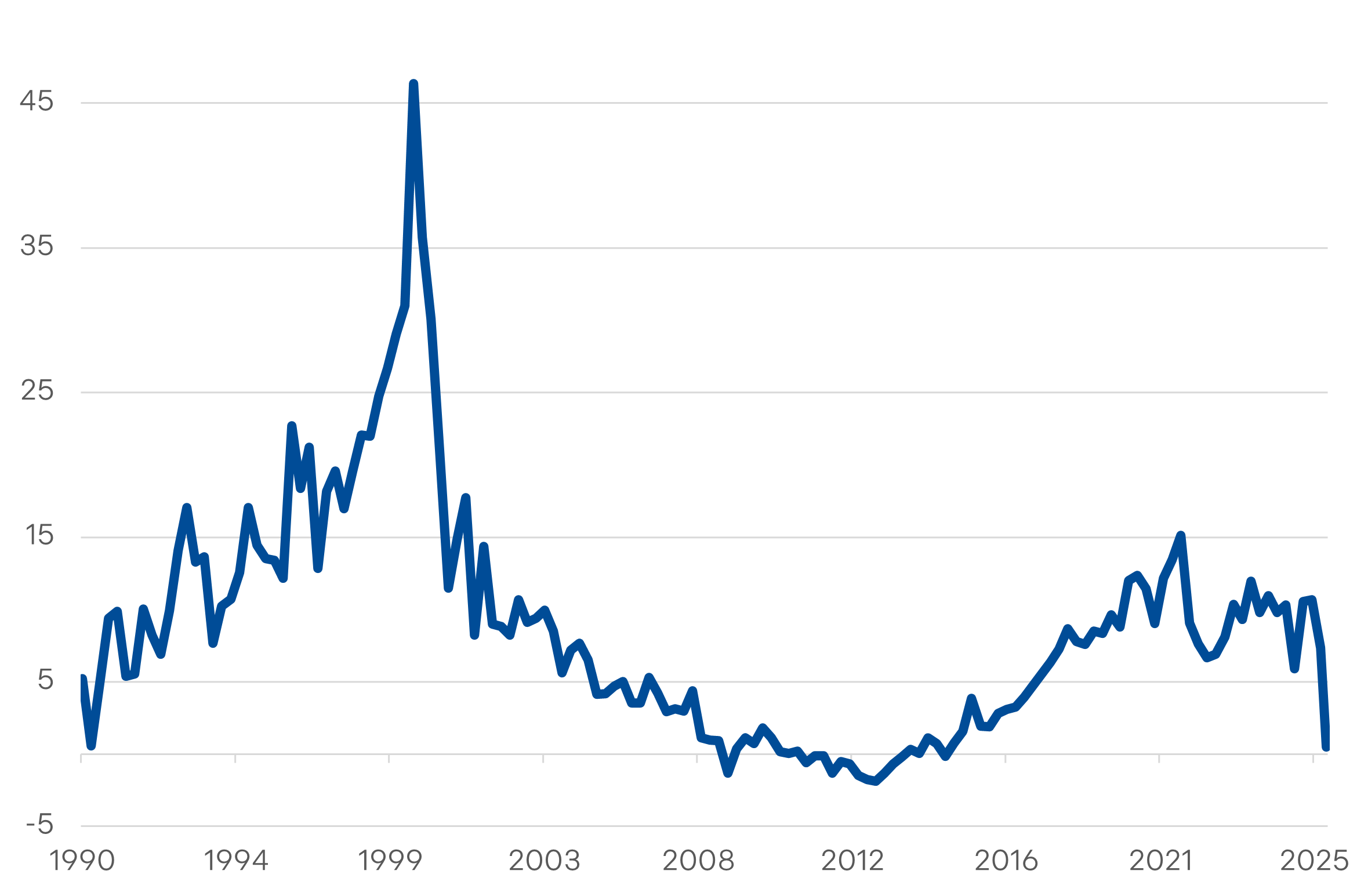
Funds in focus: Brompton Tech Leaders Income ETF (TLF) Recent artificial intelligence breakthroughs, particularly generative AI and large language models, have the potential to redefine how software is built, priced, and consumed. While AI promises long-term productivity gains and new revenue pools, the transition has driven meaningful intra-sector dispersion within technology. Year to date the S&P 500 Software Index is down 21% versus the PHLX Semiconductor Index up 14% and the S&P 500 is essentially flat.1 This divergence reflects a cyclical AI tailwind for semiconductors — where infrastructure buildout and GPU demand translate directly into revenue — versus deeper structural uncertainty in software around monetization, pricing models, and long-term economics. We believe the software sector is undergoing its most profound structural shift since the emergence of cloud computing and software-as-a-service. The S&P 500 Software Index is currently trading at roughly a 0.5x forward P/E premium to the broader market (14th percentile), well below the historical median premium of 7.7x. The last comparable valuation reset occurred during the early cloud migration cycle, when business models were repriced amid platform transition risk. Unlike prior cycles, today’s compression is not purely macro-driven — it reflects a reassessment of competitive moats, pricing durability, margin structure and AI monetization credibility. |
|
|
|
AI is reshaping the software value chain and compressing the traditional software stack. Historically, application software companies captured value through proprietary workflows, data lock-in, and seat-based licensing. Today, foundational AI models are enabling horizontal capabilities—automation, copilots, search, and content generation—that can be embedded across products. AI can replicate features that once differentiated SaaS platforms leading to commoditization of features. In addition, AI could drive lower switching costs as workflow automation and API-based integration reduce customer stickiness. We believe software vendors could see pricing pressures as customers increasingly expect AI capabilities to be bundled rather than sold as premium add-ons. AI workloads are compute-intensive, aligning pricing with consumption rather than licenses thus shifting the economic model from seat-based to usage-based. AI does not necessarily mean the death of software but a paradigm shift that will result in winners and losers. Infrastructure and platform enablers will capture AI-related compute demand directly. Data-rich vertical software companies with proprietary, domain-specific datasets (healthcare, financial services, industrial automation) can defensibly layer AI on top of unique data assets. Software is transitioning from a growth-at-any-price paradigm to a capital discipline and AI monetization cycle. Near-term volatility is likely to persist as earnings revisions reflect margin resets and uncertain AI return on investment. However, long-term productivity gains from AI integration could ultimately expand total addressable markets for differentiated vendors. We believe active investing is important given significant dispersion in the tech sector. Investors must navigate between concentration risk at the top and be disciplined in capital rotation to second-order beneficiaries and emerging diffusion opportunities downstream. Investors should avoid broad sector exposure and instead focus on companies with defensible data assets, scalable distribution, and credible AI monetization pathways. The AI era will not eliminate software—but it will meaningfully reshape where value accrues within the stack. Brompton’s ApproachBrompton takes an active approach to investing in technology companies, particularly in our technology fund, Brompton Tech Leaders Income ETF (TLF, TLF.U) and in the technology holdings in Brompton Global Dividend Growth ETF (BDIV). We prefer to invest in companies that have market leading positions, a combination of revenue growth and free cash flow generation and expanding pipeline of opportunities. In TLF we actively manage our weights to software, semiconductor, IT services and hardware stocks. In addition, we use an active call writing overlay in order to earn option premiums and lower the overall volatility of returns associated with owning a portfolio of equity securities. This has enabled TLF to be awarded the LSEG Lipper Fund Award for Best Sector Equity Fund over 10 years.2 |
| As of February 28, 20263 | 1 Year | 3 Years | 5 Years | 10 Years | Since Inception TLF (20/05/2011) | Since Inception TLF.U (08/08/2019) |
|---|---|---|---|---|---|---|
| Brompton Tech Leaders Income ETF – CAD-hedged (TLF) | 17.9% | 25.0% | 13.4% | 19.4% | 14.2% | – |
| Brompton Tech Leaders Income ETF – USD (TLF.U) | 20.7% | 27.0% | 14.9% | – | – | 19.8% |

Varun Choyah
Assistant Vice President & Associate Portfolio Manager
Mr. Choyah specializes in equity security selection with a focus on the global technology and healthcare sectors. Previously, he was a research associate covering technology equities at various Canadian investment dealers for nearly a decade.