
Funds in focus: Brompton Tech Leaders Income ETF (TLF) | Brompton Technology HighPay ETF (PAYT)
Artificial intelligence (AI) has been one of the defining investment themes of recent years, driving extraordinary capital spending, earnings growth and equity market returns. However, the recent selloff has raised questions about whether the AI boom has become a speculative bubble. Concerns over elevated valuations, uncertain returns on data center investments, increasing leverage and crowded investor positioning have challenged market confidence. While AI’s long-term economic potential remains significant, the market is increasingly distinguishing between the promise of the technology and the financial returns required to justify today’s investment levels.
Valuations and Earnings: Expectations Matter
Unlike the dot-com bubble, today’s leading AI companies are largely established, profitable businesses supported by substantial earnings and cash flows. Nevertheless, strong fundamentals do not necessarily translate into attractive investment returns when expectations are already elevated. Recent market weakness has reduced valuations, but we believe sustainability of the AI trade will ultimately depend on whether earnings growth can keep pace with investor expectations. As the investment cycle matures, markets are likely to place greater emphasis on earnings quality, free cash flow and capital efficiency rather than revenue growth and AI exposure alone.
Data Center Spending: Where Is the Return on Investment?
Perhaps the most important unresolved question is whether the unprecedented investment in AI infrastructure will generate adequate returns. Hyperscalers are on track to spend $800 billion in capex in 2026 and consensus expects $1.1 trillion in spending in 2027.1 While cloud providers are reporting strong AI-related growth, the ultimate return on invested capital remains uncertain. According to Goldman Sachs, realized return on invested capital (ROIC) among hyperscalers has declined from approximately 40% to 25% in recent years, suggesting that the rapid expansion of capital-intensive infrastructure is already weighing on overall capital efficiency.2 Rising depreciation expenses, energy requirements and the risk of technological obsolescence could place further pressure on profitability, particularly if AI monetization develops more slowly than expected.
Hyperscalers Return on Invested Capital
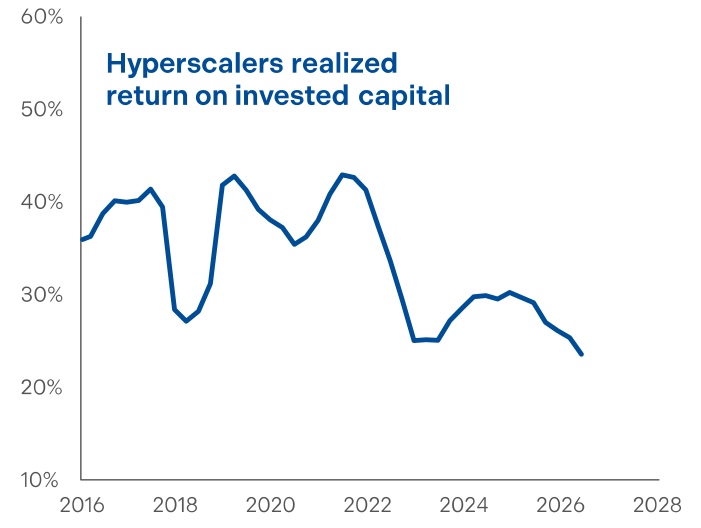
Source: Goldman Sachs, September 2026
The scale of revenue required to justify future investment is equally striking. Goldman Sachs estimates that hyperscalers would need to generate approximately $308 billion in annual AI revenue simply to break even on the assumed 2026–2027 investment base, as shown in the chart below. That requirement rises to $417 billion to achieve a 10% ROIC, $526 billion for a 20% return and $636 billion for a 30% return. These estimates highlight the significant gap between the scale of infrastructure investment and the commercial returns needed to support it. Importantly, the calculations are scenario-based rather than forecasts of actual AI revenue, while the historical ROIC figures reflect broader hyperscaler operations rather than AI infrastructure alone.
Revenue and ROIC Sensitivity
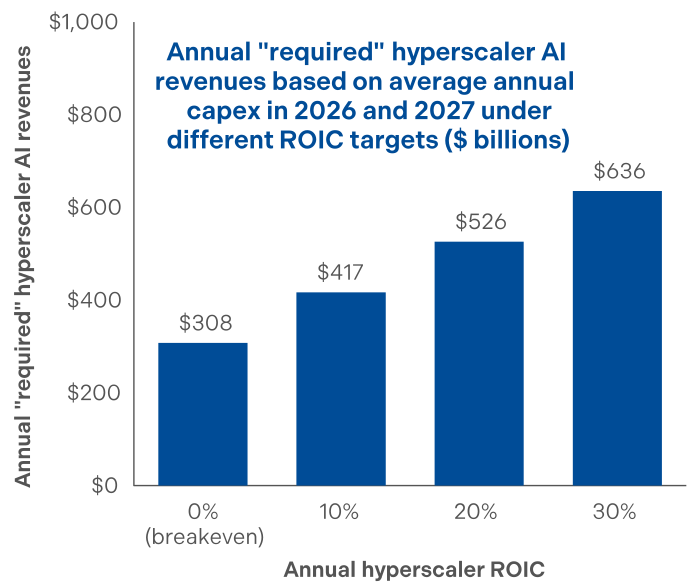
Source: Goldman Sachs, September 2026
For investors, the critical issue is no longer simply whether AI demand will continue growing, but whether that growth will translate into attractive returns on the enormous capital being deployed. Even if AI adoption exceeds expectations, disappointing returns on infrastructure investments could lead to reduced capital spending, lower earnings expectations and valuation compression across the broader AI ecosystem. This reinforces the importance of capital discipline, sustainable free cash flow and a clear path to monetization when evaluating long-term AI investment opportunities.
Leverage and Credit Markets: A Growing Source of Risk
The financing of AI infrastructure is becoming an increasingly important source of risk. While the initial wave of investment was largely funded through the substantial cash flows of major technology companies, the accelerating buildout of data centers has increased reliance on corporate debt, private credit and other financing arrangements. This introduces additional vulnerabilities, particularly for companies whose investment commitments are growing faster than their ability to generate sustainable cash flow. Rising depreciation expenses, higher financing costs and uncertainty surrounding returns on invested capital could place further pressure on balance sheets if AI monetization falls short of expectations.
Credit markets are already beginning to differentiate between companies based on their financial strength and exposure to AI infrastructure spending. Credit default swap (CDS) spreads have widened significantly across several AI-related companies, with particularly pronounced increases for CoreWeave and Oracle, as shown in the chart below. CoreWeave’s CDS spreads have experienced extreme volatility, reflecting heightened concerns surrounding its leveraged business model and substantial infrastructure commitments. Oracle has also experienced meaningful spread widening, while companies such as Alphabet, Amazon and Meta have seen comparatively modest increases. This divergence suggests that credit investors are becoming increasingly sensitive to leverage, capital intensity and the ability to convert AI-related investment into sustainable cash flows.
The widening dispersion in credit spreads is particularly important because it highlights a potential transmission mechanism from financial markets to the real economy. Should credit conditions tighten further, higher borrowing costs and reduced access to financing could force more leveraged infrastructure providers to moderate capital spending, potentially affecting demand across the broader AI supply chain. While the largest hyperscalers generally retain strong balance sheets, the growing dependence on external financing among other AI infrastructure participants introduces an additional layer of systemic vulnerability. As a result, we believe the credit market developments could serve as an important early warning indicator of stress in the AI investment cycle, even before a material slowdown becomes evident in reported earnings.
Cost of Insuring Against Default Risk
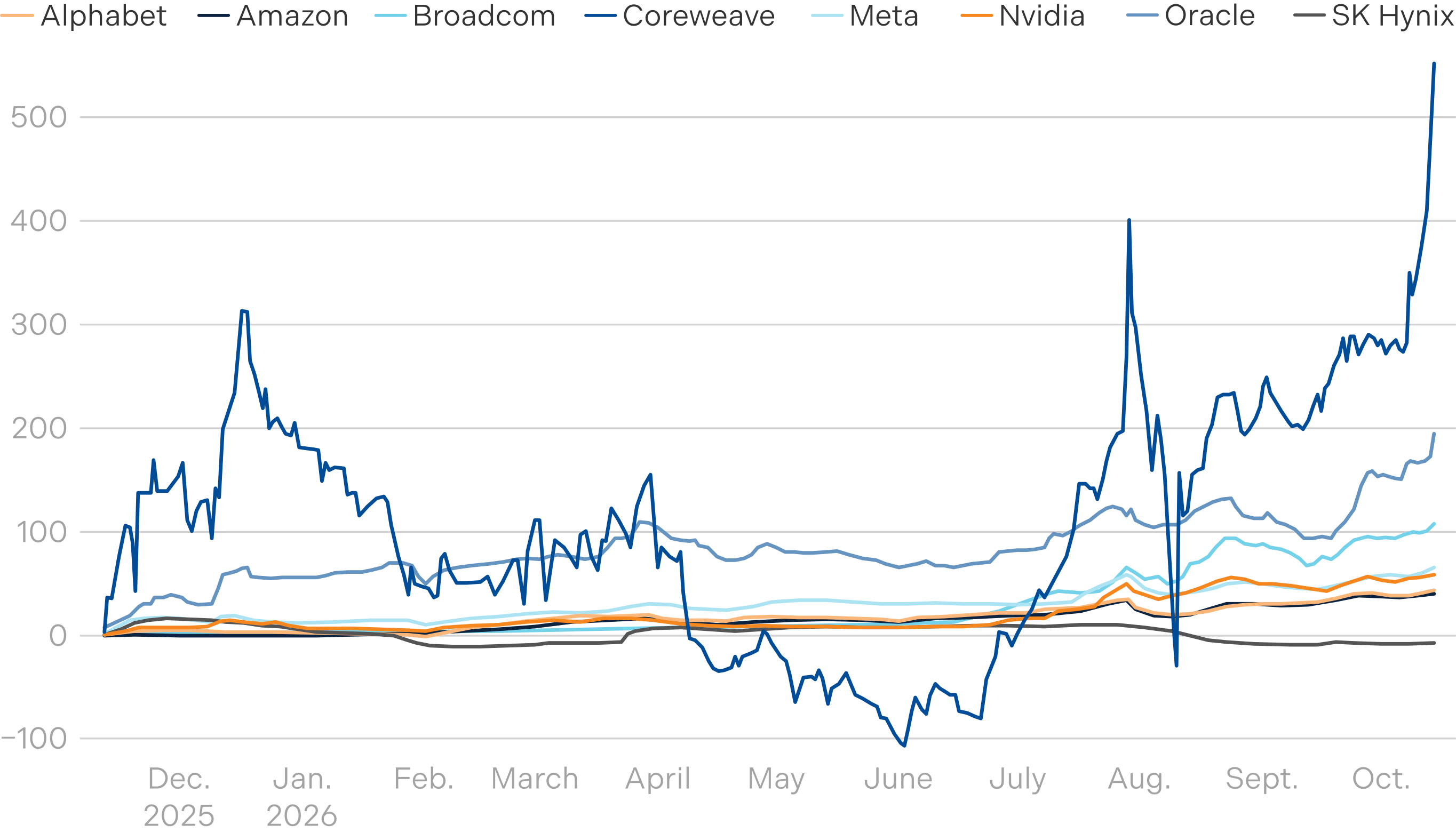
Source: S&P Global Market Intelligence, Reuters, October 2026
Crowded Positioning: The Risk of Violent Momentum Unwinds
Beyond fundamentals, investor positioning has become an important source of market vulnerability. AI-related equities have attracted substantial capital from institutional investors, hedge funds, momentum strategies and passive investment vehicles, creating significant concentration in a relatively narrow group of companies. When positioning becomes crowded, even modest disappointments can trigger disproportionate price movements. Profit-taking, systematic selling, leverage reductions and forced liquidations can reinforce one another, producing violent momentum unwinds that extend well beyond what underlying fundamentals would justify. The sharp technology selloff in early November illustrated this vulnerability, with hedge funds aggressively reducing exposure and momentum strategies experiencing exceptional losses. Such corrections do not necessarily indicate that the AI investment thesis has failed, rather, they demonstrate how crowded positioning can magnify volatility when market sentiment shifts.
Investment Implications: From AI Enthusiasm to Investment Discipline
The recent correction does not necessarily mark the end of the AI investment cycle, but we believe it may signal a transition toward a more selective and fundamentally driven market. History demonstrates that transformative technologies can deliver substantial economic benefits even when early investment expectations prove excessive. The key distinction is between the long-term success of AI and the returns earned by investors at prevailing valuations. Companies capable of converting AI demand into sustainable earnings and free cash flow, while maintaining strong balance sheets and disciplined capital allocation, may be better positioned to navigate the next phase. For active investors, heightened volatility and increasingly differentiated fundamentals could create opportunities to identify quality businesses at more attractive valuations.
The AI trade may not be over, but the era of rewarding AI exposure indiscriminately appears increasingly vulnerable. We believe future returns will depend less on the scale of investment and more on the economic value that investment ultimately creates.
Brompton’s Approach
Brompton takes an active approach to investing in technology companies in Brompton Tech Leaders Income ETF (TLF, TLF.U) and Brompton Technology HighPay ETF (PAYT). We select technology companies based on competitive positioning and growth prospectus, among other factors. In addition, we use an active call writing overlay in order to earn option premiums and lower the overall volatility of returns associated with owning a portfolio of equity securities.
1 Bloomberg. Goldman Sees Hyperscaler AI Capex Rising 50% to $1.2 Trillion. September 25, 2026.
2 Goldman Sachs, September 2026.
This report is for information purposes only and does not constitute an offer to sell or a solicitation to buy the securities referred to herein. The opinions contained in this report are solely those of BFL and are subject to change without notice. BFL makes every effort to ensure that the information has been derived from sources believed to be reliable and accurate. However, BFL assumes no responsibility for any losses or damages, whether direct or indirect which arise from the use of this information. BFL is under no obligation to update the information contained herein. The information should not be regarded as a substitute for the exercise of your own judgment. Please read the prospectus before investing.
Commissions, trailing commissions, management fees and expenses all may be associated with exchange-traded fund investments. Please read the prospectus before investing. Exchange-traded funds are not guaranteed, their values change frequently and past performance may not be repeated.
Information contained in this document was published at a specific point in time. Upon publication, it is believed to be accurate and reliable, however, we cannot guarantee that it is complete or current at all times. Certain statements contained in this document constitute forward-looking information within the meaning of Canadian securities laws. Forward-looking information may relate to matters disclosed in this document and to other matters identified in public filings relating to the ETFs, to the future outlook of the ETFs and anticipated events or results and may include statements regarding the future financial performance of the ETFs. In some cases, forward-looking information can be identified by terms such as “may”, “will”, “should”, “expect”, “plan”, “anticipate”, “believe”, “intend”, “estimate”, “predict”, “potential”, “continue” or other similar expressions concerning matters that are not historical facts. Actual results may vary from such forward-looking information. Investors should not place undue reliance on forward-looking statements. These forward-looking statements are made as of the date hereof and we assume no obligation to update or revise them to reflect new events or circumstances.